Every interview starts with "Tell me about yourself."
Most people answer with their name, city, college, and years of experience.
That's not an introduction. It's your CV out loud. And they already have it.
Princeton research found first impressions can form in 100 milliseconds.
Problem: Generic introductions make you sound like everyone else that week.
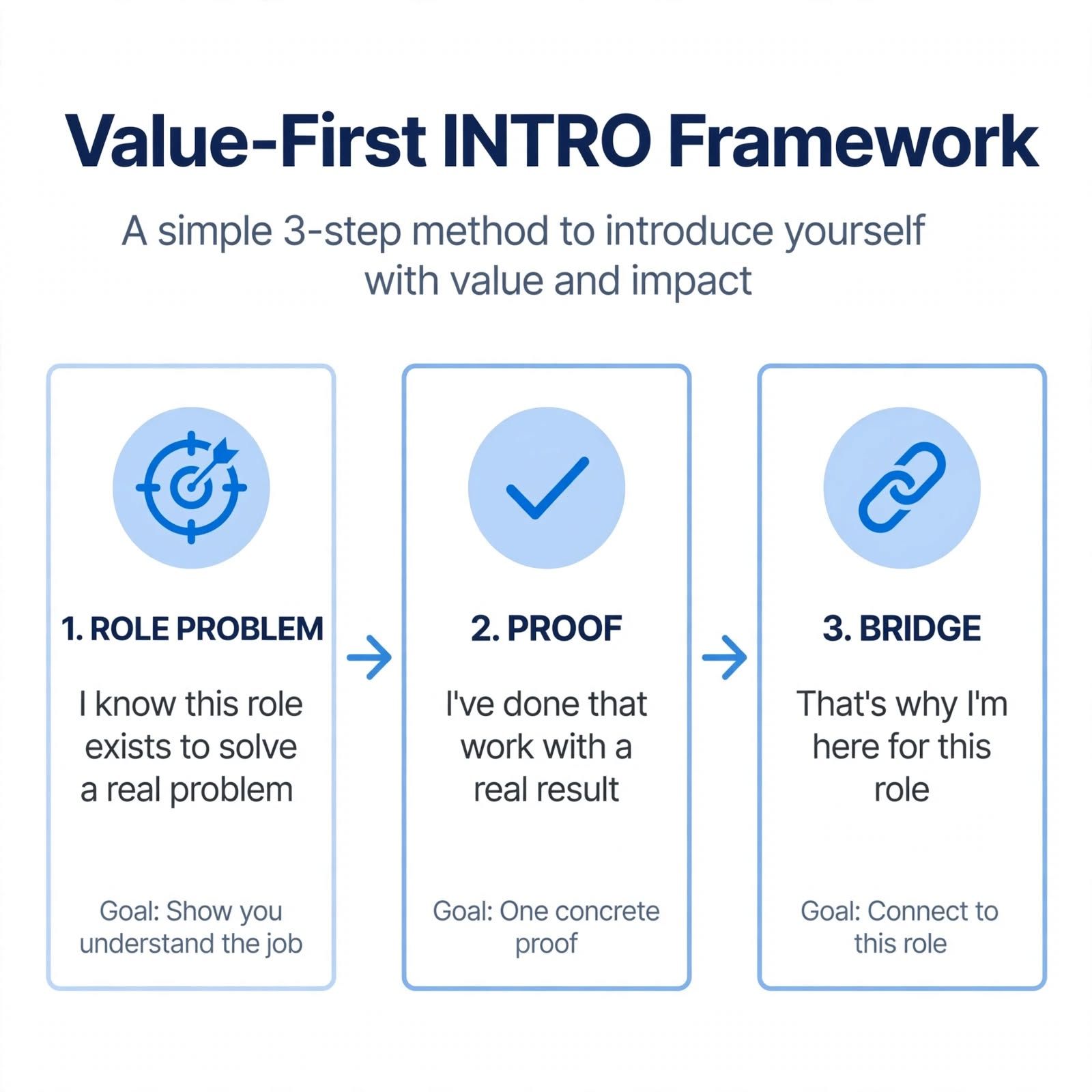
Framework: The 3-Part Value-First INTRO, Role Problem / Proof / Bridge.
Payoff: Start with value, not biography, and make the role-to-you connection obvious in one line.
Framework-at-a-Glance
| Part | What to Say | Goal |
|---|---|---|
| 1. Role Problem | I know this role exists to solve a real problem. | Show you understand the job. |
| 2. Proof | I've done that work with a real result. | Give one concrete proof point. |
| 3. Bridge | That's why I'm here for this role. | Connect your proof to this role. |
Final one-liner to replace your intro
"I focus on solving the exact problem this role was created for — and I've done that work before. That's why I'm here."
1. Role Problem — Start With Their Problem, Not Your Name
Most intros fail because they are self-centered. The interviewer meets 10 people like you that week. Same colleges. Same skills.
They are filtering for one question:
Does this person understand what this role actually needs?
Starting with the role's core problem flips the dynamic. You signal awareness in the first 5 seconds.
Example: For a growth role, don't say:
"I'm from Hyderabad."
Say:
"I know this role is about turning zero-budget attention into real growth."
Template:
"I understand this role is hired to solve [insert #1 problem from JD]."
2. Proof — One Result, Not a Timeline
Your proof should not be a chronology. It should be one relevant result that maps to the problem you just named.
This keeps it universal. A fresher can use a project. A 10-year pro can use a work win.
Vague claims kill trust. Specific proof builds it.
Example: Instead of:
"I have 3 years of experience."
Say:
"I cut manual reporting by 40% by building an internal tool."
Checklist:
- Starts with an action verb
- Includes one number
- Under 15 words
3. Bridge — Why You + This Role Makes Sense
This is the part most people skip. They list skills and stop.
You need to explicitly connect your proof to this job.
Without a bridge, you sound generic. With a bridge, you sound intentional.
Example:
"That's the exact retention problem you're hiring for, and that's the work I do best."
Template:
"That's why this role and I align — you've got [role problem], I've solved [my proof]."
Full 30-Second Spoken Example — Marketing
"I know this role is about turning messy campaign data into clear growth decisions. I did that by building a dashboard that cut manual reporting by 40% for 2 brands. That's the exact problem you're hiring for, and that's the work I do best. I'm Harini, by the way."
Second Example — Software Role
"I know this role is about reducing production bugs before release. I built a test suite that caught 30% more edge cases in my internship. That's the exact release risk you're hiring for, and that's the work I do best."
HotJPT Take
Most advice tells you to be confident. That's not the issue. The issue is structure and risk.
In screening calls, recruiters filter for clarity. In hiring manager rounds, managers filter for judgment — will this person solve my problem, or will I have to train them to understand it?
Value-first introductions work because they mirror how hiring managers think. They don't think in biographies. They think in problems and proof.
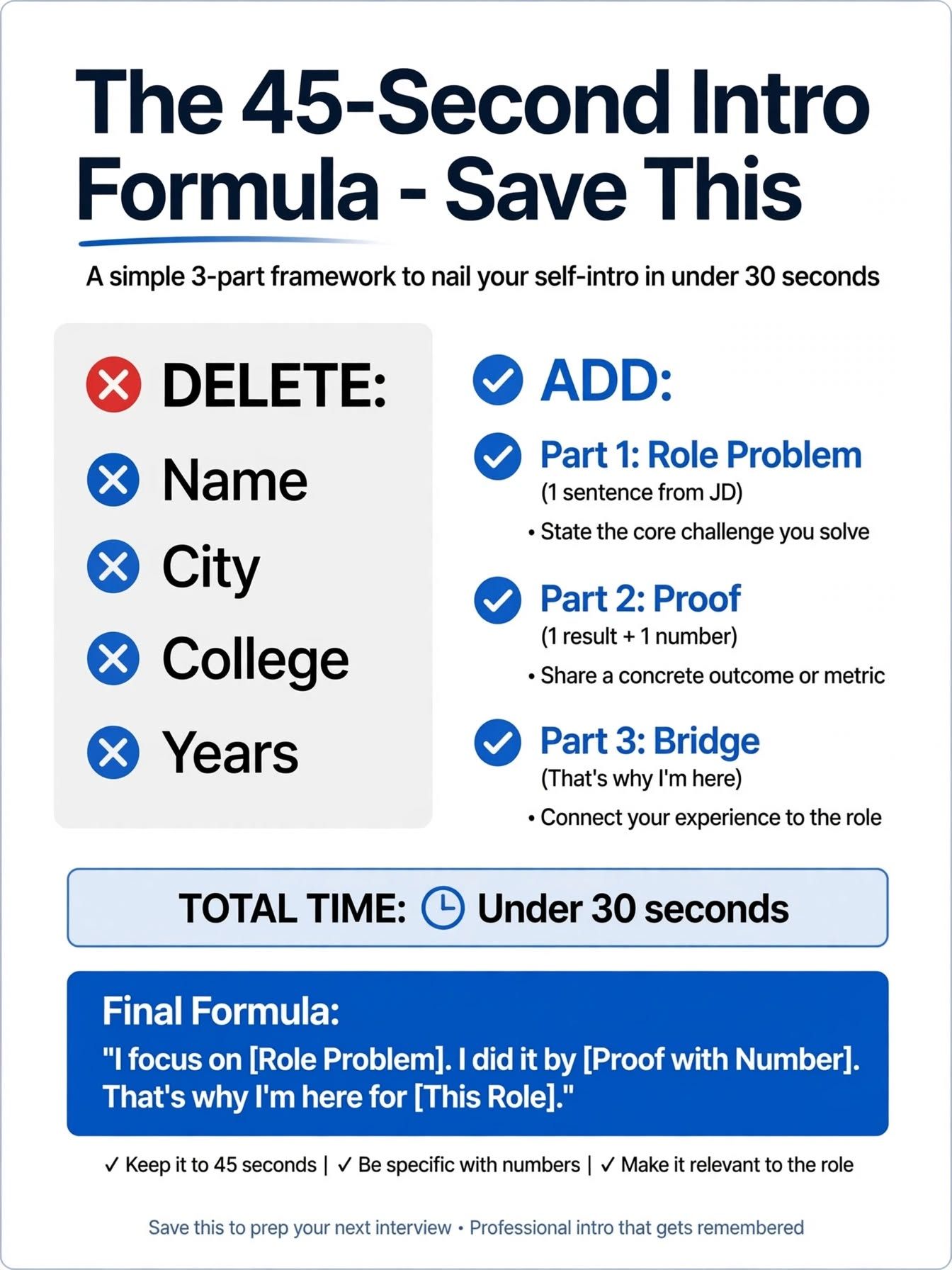
Save This - The 45-Second Intro Formula
DELETE: Name, city, college, years in the first 2 lines
ADD Part 1: Role Problem — 1 sentence from the JD
ADD Part 2: Proof — 1 result + 1 number
ADD Part 3: Bridge — "That's why I'm here for this role."
TOTAL TIME: Under 30 seconds when spoken
Final Formula
I focus on [Role Problem]. I did it by [Proof with Number]. That's why I'm here for [This Role].
Final Takeaway
Don't start with your biography. Start with your value.
One clear line beats a three-minute CV every time.
Frequently Asked Questions
1. How should I answer "tell me about yourself" as a fresher?
Use a project as proof. "I focus on solving [role problem]. I built a project that [result with number]. That's why I'm here."
Q: 2. What is a good answer for experienced professionals?
Skip the timeline. Use one recent win that matches the JD.
3. How long should my answer be?
25-30 seconds. One problem, one proof, one bridge. If it goes over 45 seconds, it's a CV, not an intro.
The HotJPT editorial team covers AI, US immigration, IT job market trends, and staffing intelligence for recruiters, bench sales marketers, and IT consultants.