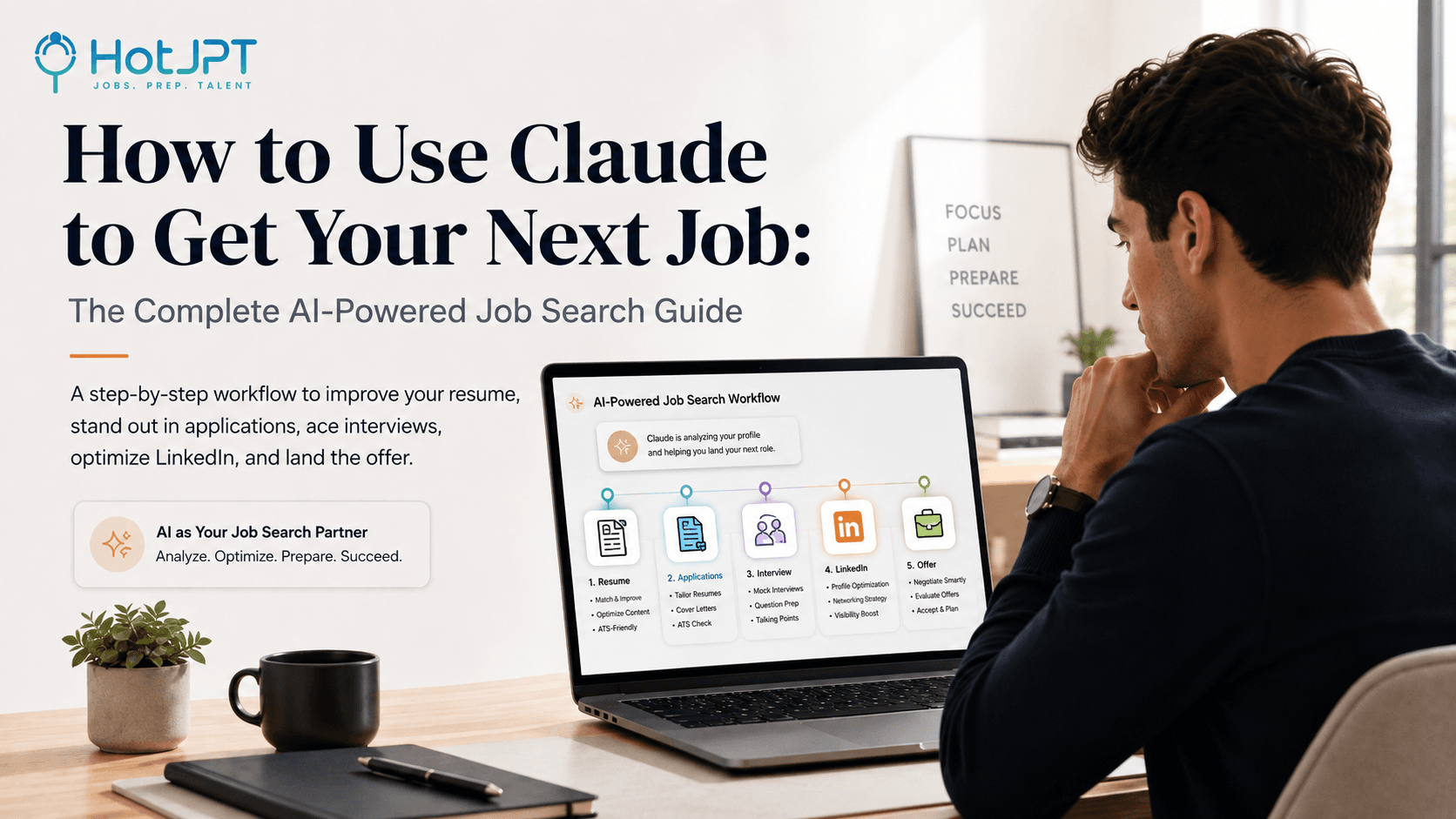
How to Use Claude to Get Your Next Job: The Complete AI-Powered Job Search Guide
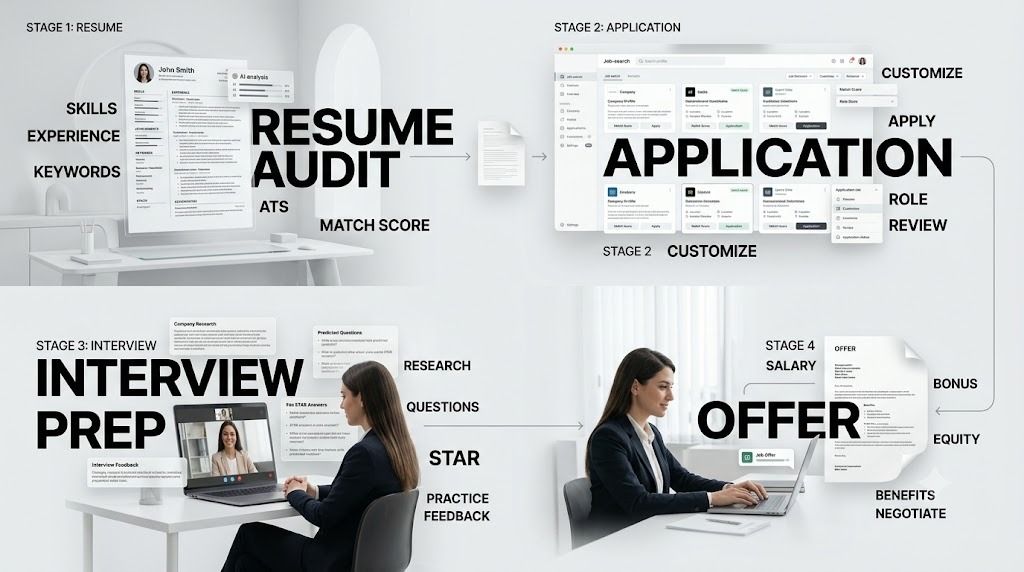
Your resume is only one part of the job hunt.
From finding gaps in your resume and improving ATS compatibility to preparing for interviews, optimizing LinkedIn, negotiating compensation, and following up with recruiters, Claude can help you build a more systematic job-search workflow.
The key is not simply asking Claude to "improve my resume." The better strategy is to give it a specific role, provide the right context, and make it evaluate your application from multiple perspectives.
This guide gives you a complete Claude-powered workflow for moving from resume → application → interview → offer.
Important: AI should support your job search, not replace your judgment. Always verify information, replace placeholders with your real achievements, and review applications before submitting them.
What You'll Need
Before starting, gather these essentials:
- A Claude account
- Your latest resume in PDF, Word, or text format
- The job description for the position you're targeting
- Your LinkedIn profile information
- For automated applications: Claude Pro, Cowork, Chrome, and the required browser integration
For the best results, keep your resume and the relevant job description available in the same Claude conversation whenever possible. This allows Claude to maintain context between the different stages.
Table: Prompt Library
Step 1: Find Out Where Your Resume Stands
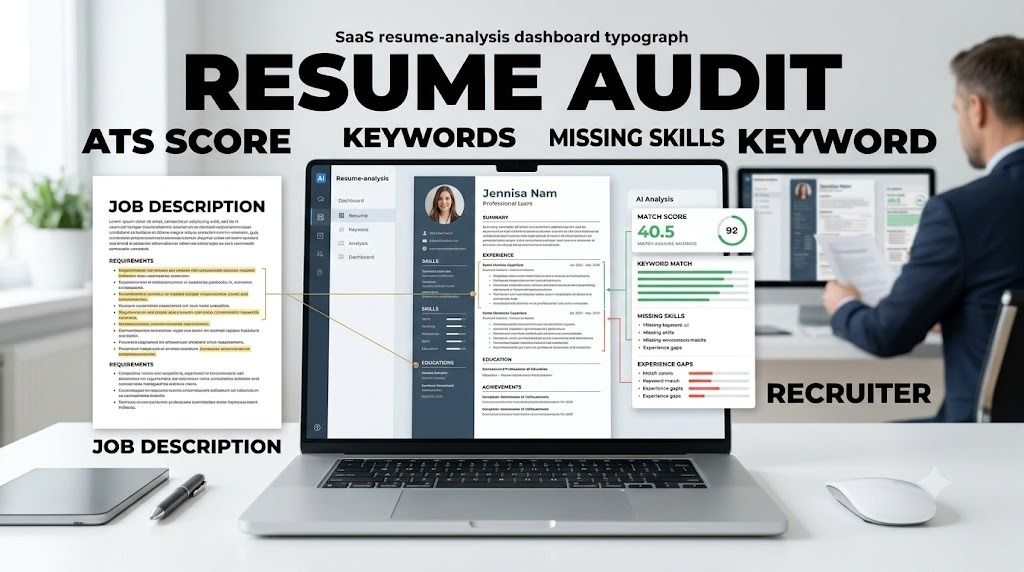
Before changing your resume, find out what is actually wrong with it.
Instead of immediately asking Claude to rewrite everything, first make it evaluate your resume against the specific position you're pursuing.
This gives you a baseline: how closely your experience matches the role, what keywords you're missing, what might concern a recruiter, and where your strongest selling points are.
Prompt 1
Act as a senior recruiter for this exact company.
Analyze my resume against this job description.
Give me:
1. A match score out of 100
2. The top 5 missing keywords that the ATS will be scanning for
3. The 3 red flags a hiring manager would spot in under 10 seconds
4. Which sections are strong and why
5. Which sections are weak and why
6. How my resume compares to what a strong candidate for this role would look like
Be brutally honest. I would rather fix problems now than get ghosted later.
Don't treat the score as an absolute prediction of whether you'll get hired. Use it as a diagnostic tool.
The important part is understanding why Claude believes your resume is strong or weak.
Step 2: Turn Your Experience Into Stronger Accomplishments
Once you've identified the gaps, move into rewriting.
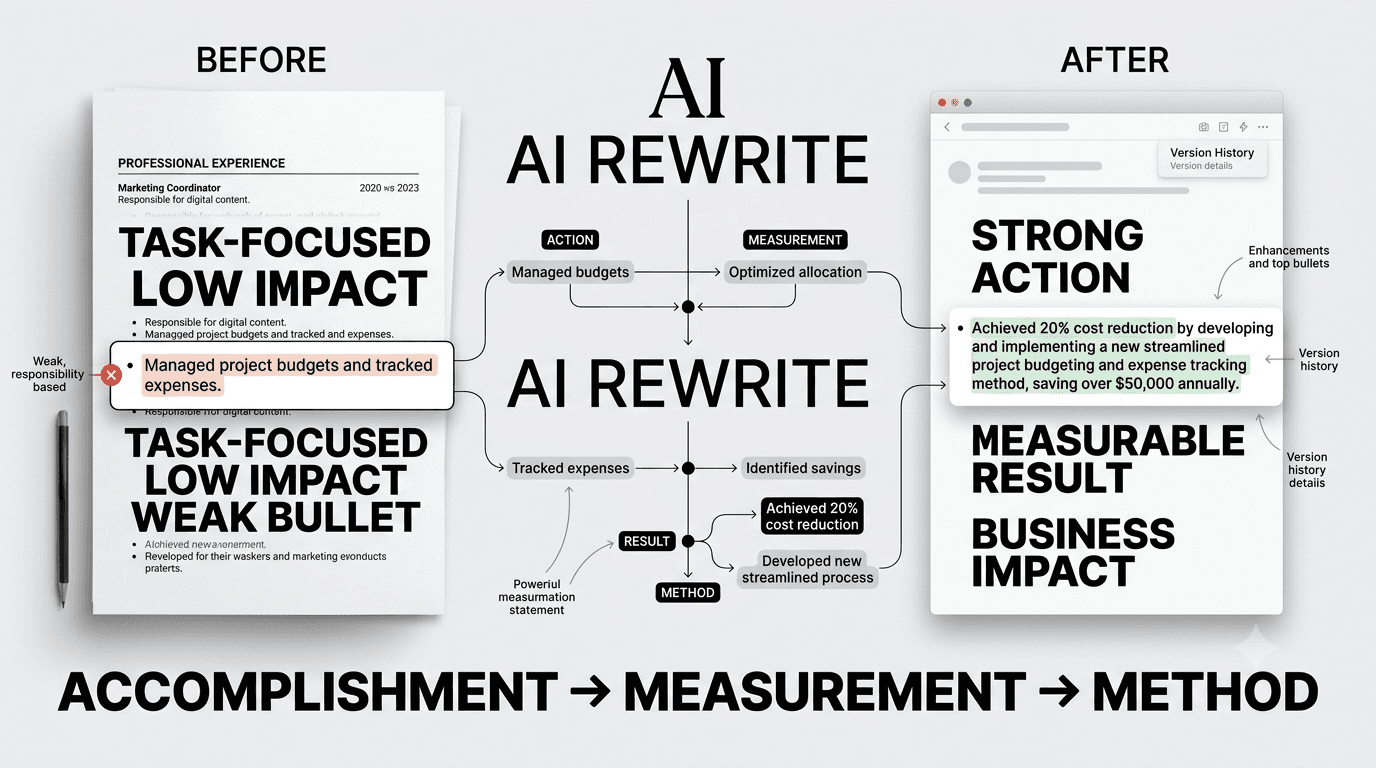
A common problem with resumes is that they describe responsibilities instead of outcomes.
Compare:
Weak:
"Managed a team of developers."
Stronger:
"Reduced deployment time by 40% by restructuring the engineering team into cross-functional pods."
The second version gives the reader an outcome, a measurable result, and an explanation of how the result was achieved.
Use the following prompt in the same conversation so Claude can use the information from the audit.
Prompt 2
Rewrite my experience section using these rules:
1. Naturally include the missing keywords you identified, but do NOT force them in. They should feel like a normal part of each bullet.
2. Remove or fix every red flag you flagged.
3. Use the Google XYZ formula for every bullet: "Accomplished [X] as measured by [Y] by doing [Z]"
4. Start every bullet with a strong action verb. Never use "Responsible for" or "Helped with".
5. Add specific numbers wherever possible. If I did not provide numbers, suggest realistic placeholders I can fill in later and mark them with [FILL IN].
6. Keep each bullet to 1-2 lines max. Hiring managers skim. Dense paragraphs get skipped.
7. Order bullets by impact, not chronology. The most impressive result goes first.
One important rule
Never allow AI to invent achievements.
If Claude suggests a metric that you cannot verify, replace it with your actual number. If you don't know the number yet, keep [FILL IN] until you can confirm it.
Your resume should become more accurate and more compelling, not more fictional.
Step 3: Test the Resume Before You Send It
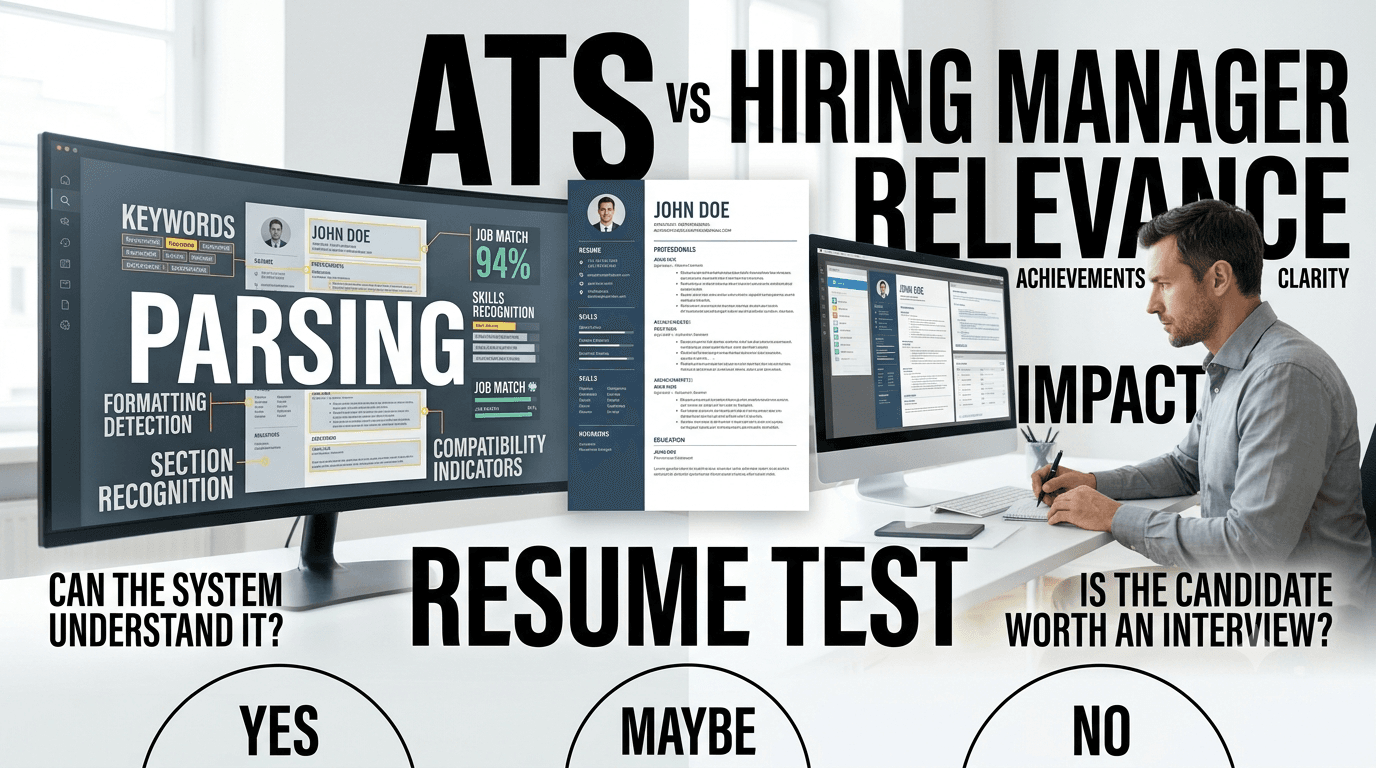
A resume can look excellent to a person and still have problems when processed by an ATS.
That's why your next step should be a two-sided review.
First, make Claude behave like the software screening your application.
Then make it behave like the recruiter who has dozens or hundreds of resumes to review.
Prompt 3
Now act as two different people:
FIRST: Act as an ATS filter. Scan my new resume and tell me:
- Would it pass the ATS for this job? (Yes/No)
- Which keywords are now present and which are still missing?
- Any formatting issues that would confuse an ATS parser? (tables, columns, headers, special characters, images)
SECOND: Act as a hiring manager who is reading 200 resumes in one sitting. Scan my resume and tell me:
- Which sections would you skip? Why?
- What makes you stop scrolling (good or bad)?
- Would you put this in the "yes" pile, "maybe" pile, or "no" pile for this role?
- Rewrite any sections that would get skipped so they actually stop the scroll.
Give me the final version of my resume after all fixes are applied.
At this point, ask Claude to produce a clean final version that you can move into your preferred resume format.
Before submitting it, manually check every claim and replace any [FILL IN] fields.
Step 4: Scale Your Job Search With Automated Applications
Once your resume is ready, you can use Claude's computer-use capabilities to help with repetitive parts of the application process.
This can be useful when you're applying to many similar roles, but don't blindly automate submissions.
You want to maintain control over what gets submitted under your name.
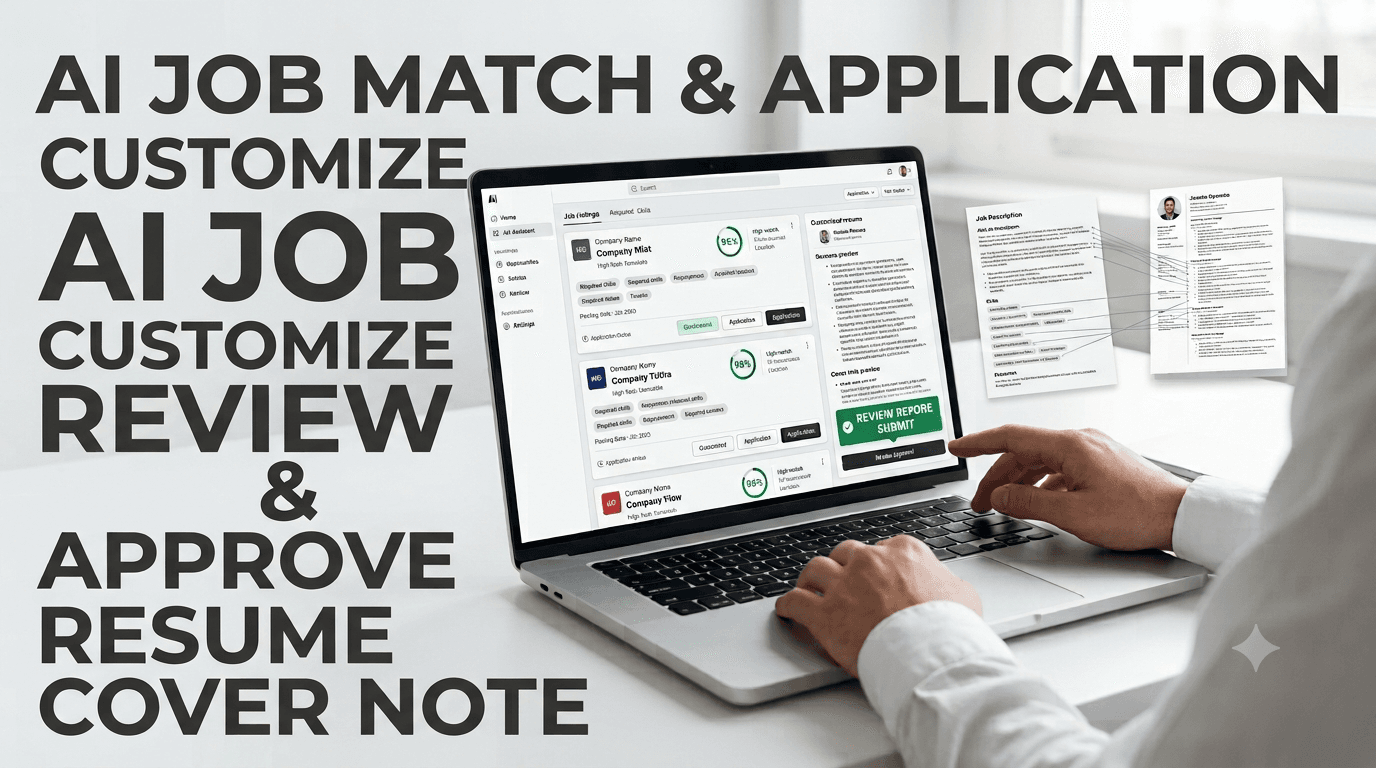
Prompt 4
Now that my resume is optimized, go to LinkedIn and do the following:
1. Search for [JOB TITLE] roles in [LOCATION] posted in the last [7/14/30] days.
2. Filter for jobs where my resume is at least a 70% match based on the skills and experience listed in the job description.
3. Pick the top 10 jobs I have the highest chance of landing an interview for.
4. For each job:
- Read the full job description
- Customize my resume summary and key bullets to match that specific role
- Write a short cover note (3 sentences max) that references something specific about the company
- Submit the application through LinkedIn
5. After all 10 are submitted, send me a summary:
- Company name + job title
- Match score
- What you customized for each
- Application status (submitted / draft)
Pause before submitting each application and show me the customized version first.
Why the final instruction matters
Keep the "pause before submitting" requirement enabled.
Applications represent you professionally, so you should review the customized resume, answers, and cover note before anything is actually submitted.
Step 5: Create a Role-Specific Cover Letter
A cover letter shouldn't simply repeat your resume.
Its job is to connect what the company needs with what you've already demonstrated.
Use the resume and job description already available in your conversation and ask Claude to build the letter around the company's specific needs.
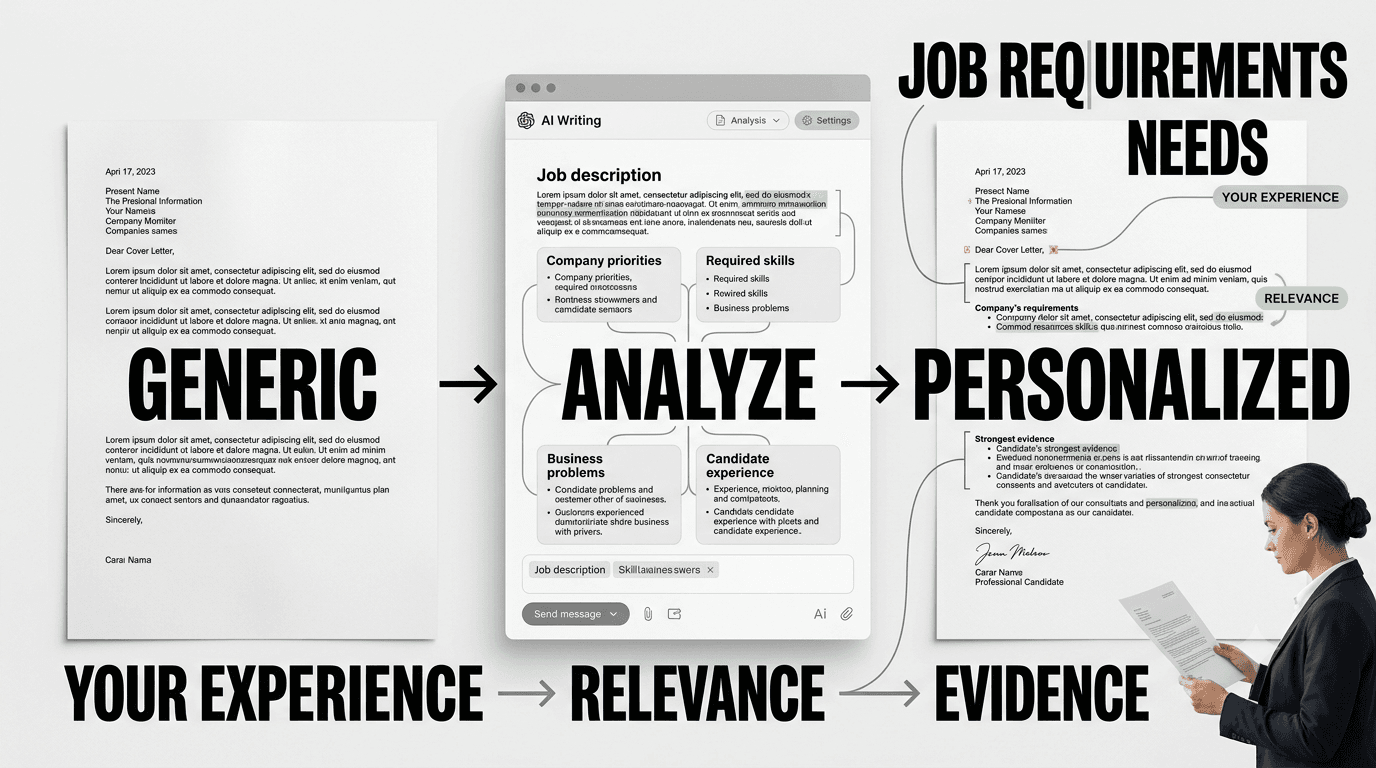
Prompt 5
Write me a cover letter for this job using my resume and the job description you already have.
Rules:
1. Open with one sentence that shows I understand their biggest current problem (use the job description as the clue)
2. Second paragraph: 2-3 specific examples from my resume that map directly to what they need
3. Third paragraph: Address one obvious gap or weakness head-on, and reframe it
4. Close with one specific reason I want to work at THIS company, not just any company
Tone: Confident, direct, no fluff, no buzzwords.
Length: Under 250 words.
Do NOT sound like AI wrote it.
The strongest part of this approach is that it doesn't pretend your profile is perfect.
If there's a genuine weakness, addressing it thoughtfully can be more convincing than pretending it doesn't exist.
Step 6: Build an Interview Preparation System
Getting an interview is only half the job.
Your next challenge is being able to explain your experience clearly, handle unexpected questions, demonstrate knowledge of the company, and ask intelligent questions yourself.
Instead of preparing random interview questions, use Claude to create a role-specific preparation system.
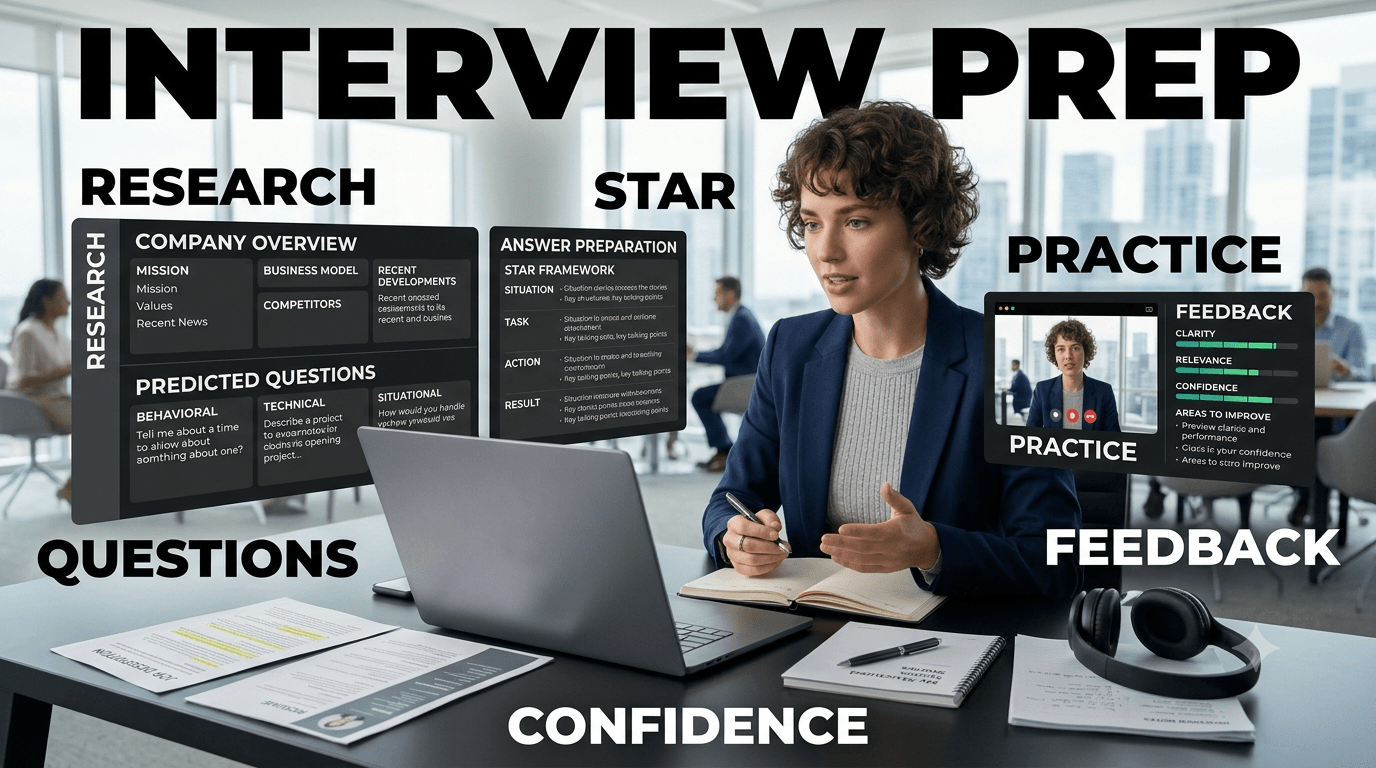
Prompt 6
I have an interview for [ROLE] at [COMPANY] on [DATE]. Help me prep.
COMPANY RESEARCH
Give me a 1-page brief on:
- What they do and how they make money
- Their biggest current challenge or opportunity (from recent news, earnings, or product launches)
- Their main competitors and how they differentiate
- Their culture and values (from their site, Glassdoor, and recent posts)
PREDICTED QUESTIONS
Based on my resume and this job description, predict the top 10 questions they will ask. Mix behavioral, technical, and situational. For each question, give me:
- Why they are likely to ask it
- A strong 60-90 second answer using a specific story from my resume
- The one trap to avoid in my answer
QUESTIONS I SHOULD ASK THEM
Give me 5 questions that show I did research and actually understand their business. Not "What does a typical day look like" generic stuff. Questions that make the interviewer think "This person gets it."
MOCK INTERVIEW
After I review the above, run a 15-minute mock interview. Ask me the top 5 questions one at a time. After each answer, give me feedback on what was strong and what to fix.
Don't stop at reading Claude's suggested answers.
The mock interview is where the real practice happens. Answer the questions yourself, preferably out loud, and use the feedback to improve your responses.
Step 7: Negotiate the Offer
If you reach the offer stage, don't automatically accept the first number you're given.
Your compensation decision should consider the market, your experience, the role's level, location, benefits, equity, bonus structure, and your own priorities.
Claude can help you organize that negotiation.
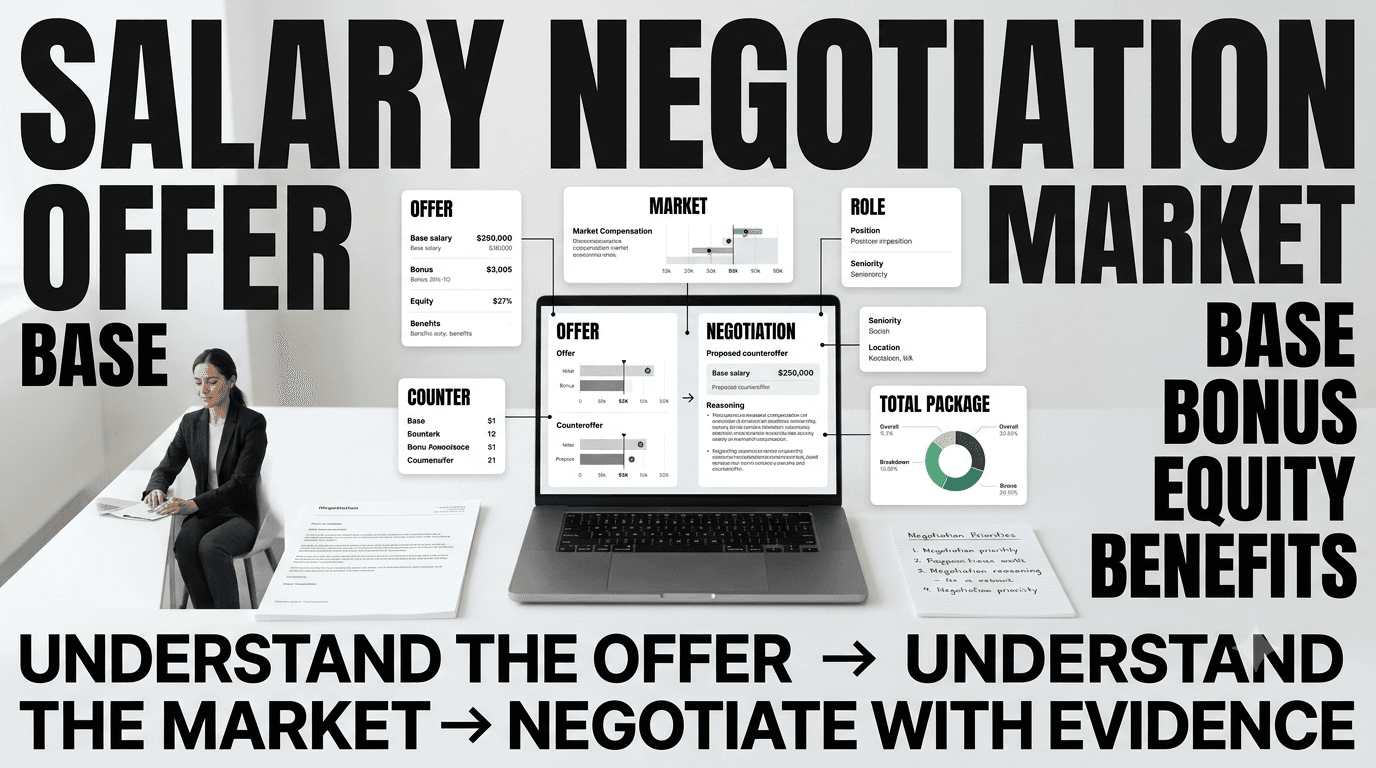
Prompt 7
I just got an offer for [ROLE] at [COMPANY]. The offer is [BASE + BONUS + EQUITY + BENEFITS]. Help me negotiate.
1. MARKET ANALYSIS
- Pull salary data for this exact role, level, company, and location
- Tell me where this offer falls (below market, at market, above market)
- Give me a specific counter-offer number with reasoning
2. EMAIL SCRIPT
- Write the exact email I should send to counter
- Express genuine excitement about the role
- Reference market data without being adversarial
- Ask for a specific number, not a range
3. PHONE CALL SCRIPT
- If they want to discuss by phone, give me the exact words to say for:
- Opening the conversation
- Stating my counter
- Handling "this is the best we can do"
- Negotiating non-salary items if base is firm (signing bonus, extra PTO, remote flexibility, start date)
4. WALK-AWAY ANALYSIS
- At what number should I accept?
- At what number should I walk away?
- What are the non-monetary factors that could make a lower offer worth taking?
One negotiation principle to remember
Don't invent competing offers or make false claims about your market value.
If you're asked about salary expectations before receiving an offer, you can keep the conversation focused on the employer's range:
"I would like to learn more about the full compensation package before discussing numbers. What is the budgeted range for this role?"
Step 8: Make Your LinkedIn Profile Work With Your Resume
Your resume is designed for applications.
LinkedIn has another job: helping recruiters discover you.
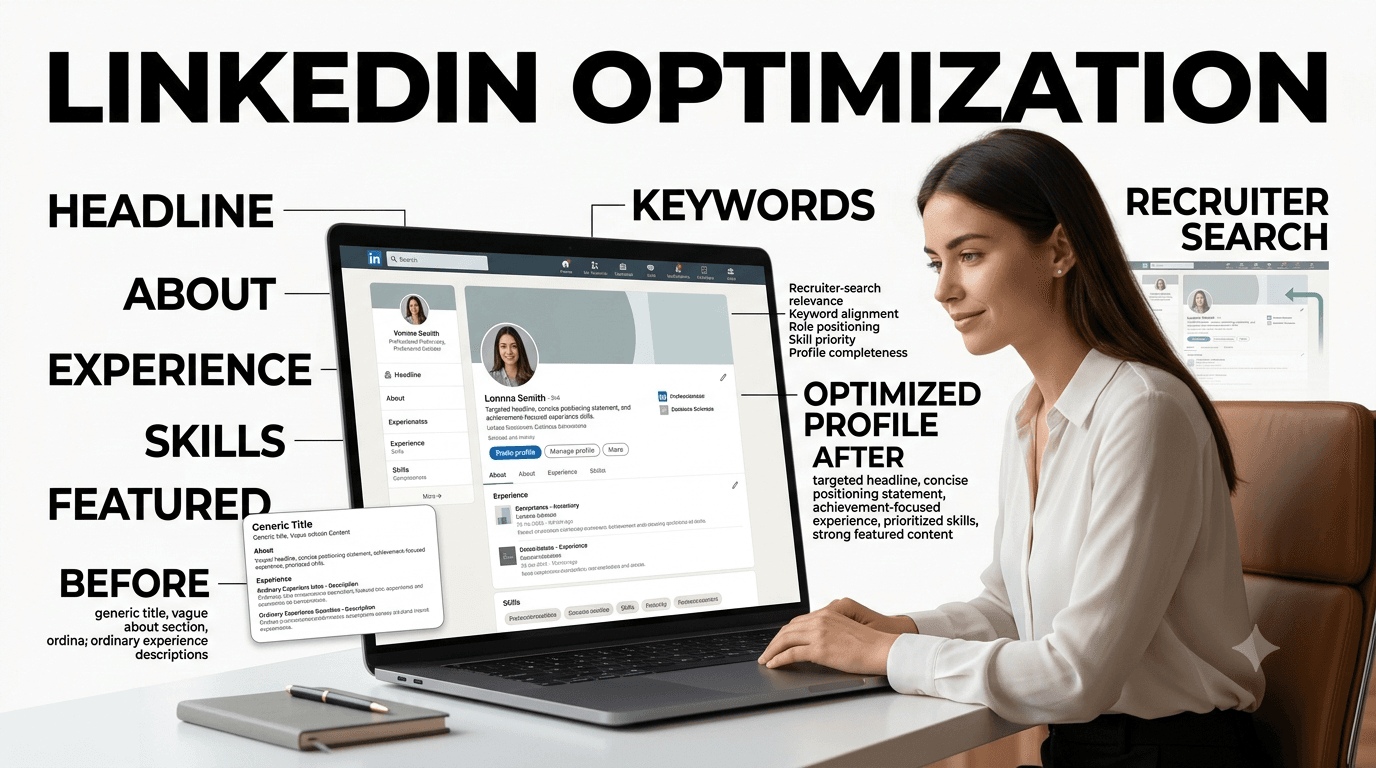
That means your profile shouldn't simply be a copy of your resume. Your positioning, keywords, headline, About section, experience, and featured content should work together.
Prompt 8
Rewrite my LinkedIn profile to attract recruiters for [TARGET ROLE] roles.
1. HEADLINE
- 3 versions, each under 220 characters
- Use keywords recruiters actually search for
- Show outcome and specialty, not just title
2. ABOUT SECTION
- First sentence has to hook. No "I am a passionate..."
- 3 short paragraphs max
- End with a clear call to action (what kinds of roles or conversations I am open to)
3. EXPERIENCE BULLETS
- Same XYZ formula from my resume
- But more conversational than resume bullets
- Add 1 line per role about what I learned, not just what I did
4. SKILLS SECTION
- Top 5 skills to pin based on the roles I am targeting
- In priority order from most searchable to least
5. FEATURED SECTION
- Suggest 2-3 things I could add (articles, projects, presentations, media) that would make a recruiter stop and look closer
After generating the profile, compare it against your actual experience.
Don't add skills simply because they are popular keywords. If you can't confidently discuss a skill during an interview, it probably shouldn't be positioned as one of your core strengths.
Step 9: Follow Up Without Sounding Desperate
Submitting an application doesn't necessarily mean the conversation is over.
Strategic follow-ups can help keep your application visible, especially when you have something specific and useful to add.
The key is avoiding generic messages such as "Just checking in on my application."
Prompt 9
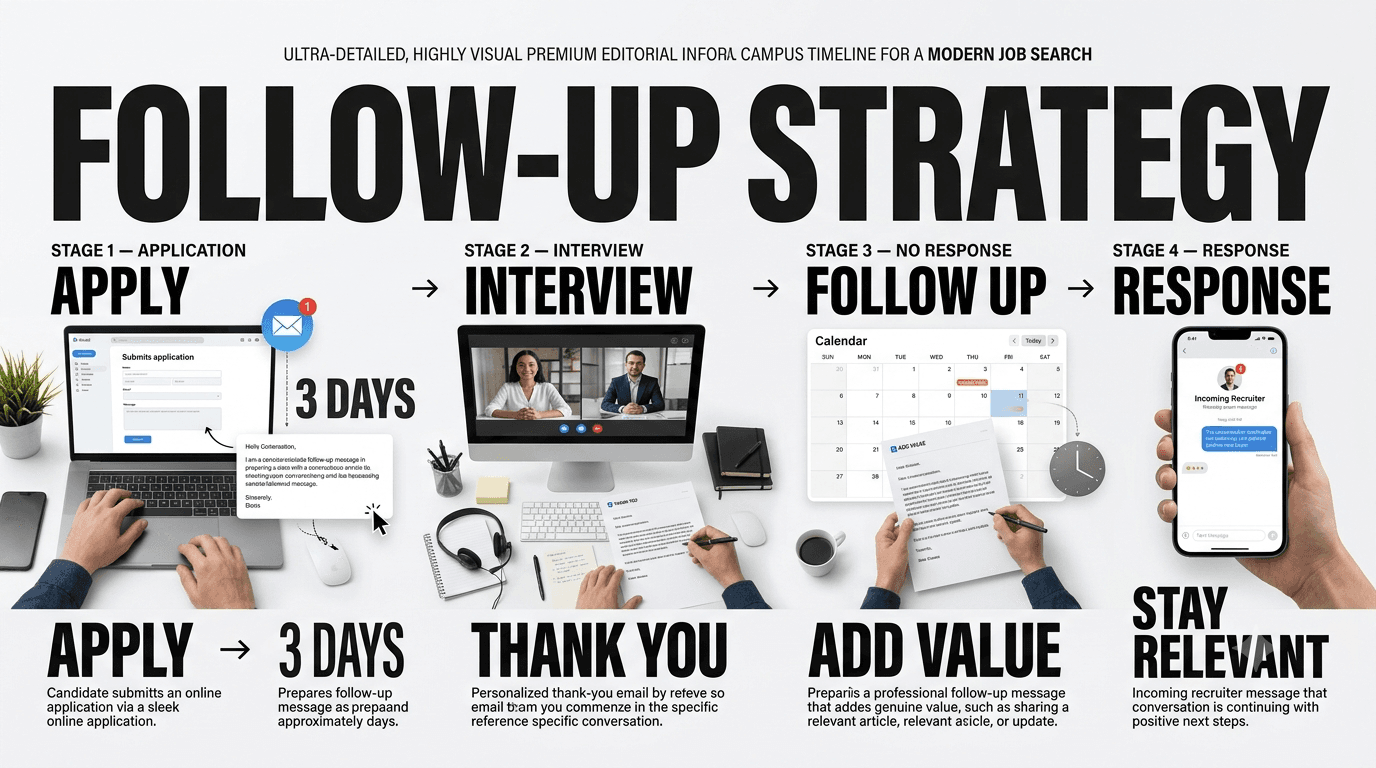
Write me 3 follow-up emails for my application to [ROLE] at [COMPANY].
1. POST-APPLICATION (3 days after applying)
- Short, confident, references one specific detail from the job post
- Restates fit in 1 sentence
- Under 60 words total
2. POST-INTERVIEW (within 24 hours)
- Thank them by name for their time
- Reference one specific moment from the conversation
- Reinforce the strongest example I gave
- Under 100 words total
3. THE NUDGE (7 days after interview, no response)
- Polite, not desperate
- Add a piece of value (relevant article, industry insight, or quick thought related to something we discussed)
- Give them an easy out: "If the timeline has shifted, totally understand"
- Under 80 words total
Tone for all: Confident, not desperate. Specific, not generic. Human, not template-y.
The goal isn't to send more messages.
It's to send better messages at the right moments.
The Complete Claude-Powered Job Search Workflow
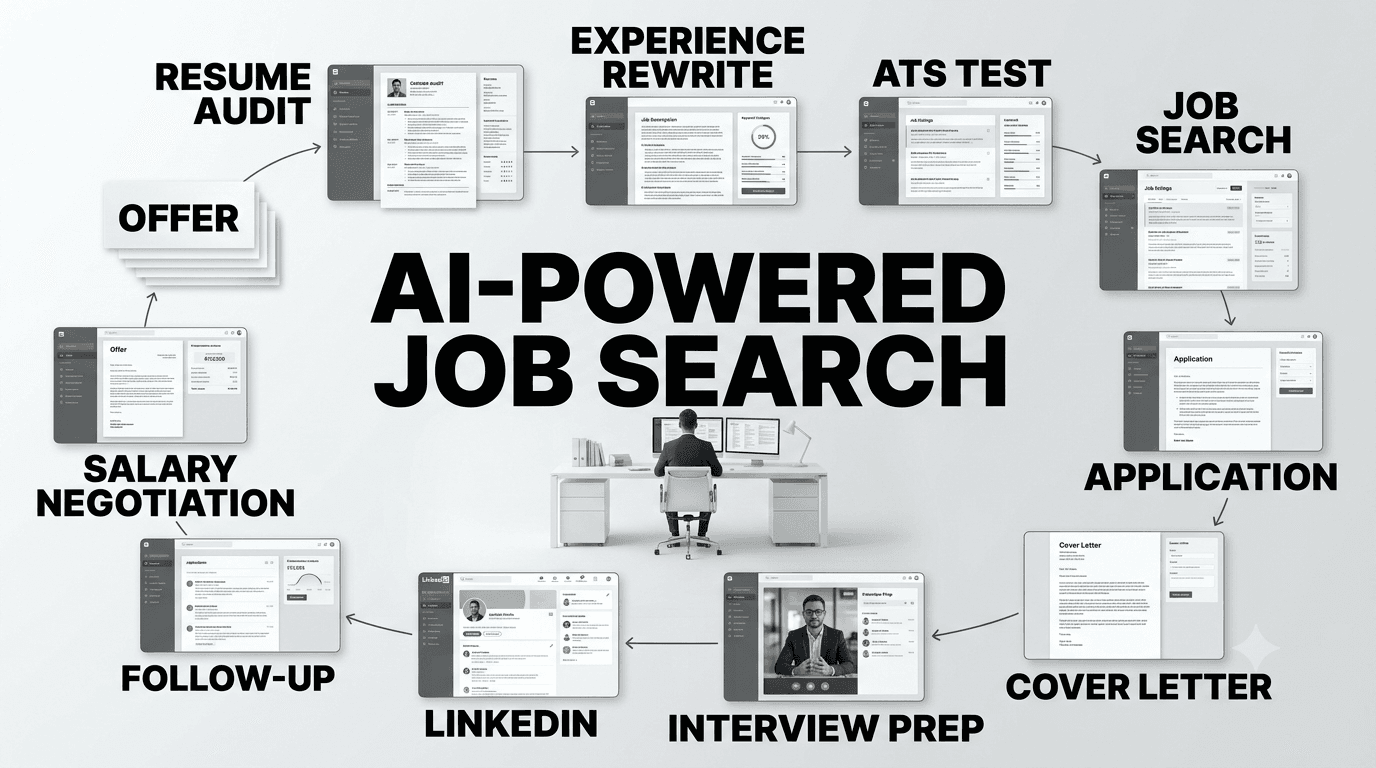
You can now connect all the pieces into one repeatable system:
1. Diagnose
Run the resume audit against the specific job.
2. Rewrite
Improve experience bullets using the identified gaps and the XYZ structure.
3. Stress-test
Evaluate the new version as both an ATS and a hiring manager.
4. Apply
Use the optimized resume for targeted applications, manually or with appropriate automation.
5. Personalize
Generate a company- and role-specific cover letter when one is useful.
6. Get discovered
Align your LinkedIn profile with the roles you're targeting.
7. Prepare
Research the company, predict questions, build answers, and run mock interviews.
8. Follow up
Send concise, relevant follow-ups instead of generic check-ins.
9. Negotiate
When an offer arrives, evaluate the market and negotiate the full package.
The Important Part: Don't Let AI Become Your Voice
Claude can help you structure your job search, identify weaknesses, generate drafts, and simulate different perspectives.
But the strongest material still comes from you.
Replace placeholders with real numbers.
Use real projects.
Tell real stories.
Verify every achievement.
Customize applications for roles that genuinely fit.
The objective isn't to create a resume that sounds impressive to an AI.
It's to create an application that makes a real recruiter or hiring manager understand why you're worth interviewing.
Use Claude for the heavy lifting.
You provide the evidence.
Frequently Asked Questions
Can Claude help optimize my resume for a specific job?
Yes. Claude can compare your resume against a specific job description, identify missing keywords, flag potential concerns, and suggest improvements. However, you should verify every suggested achievement and metric.
Can Claude help with ATS optimization?
Yes. Claude can review your resume for relevant keywords and potential formatting issues that could interfere with ATS parsing. It should be treated as a diagnostic tool rather than a guarantee that a resume will pass a particular ATS.
Can Claude write a cover letter?
Yes. You can provide your resume and job description and ask Claude to create a role-specific cover letter focused on the company's needs and your relevant experience.
Can Claude help me prepare for interviews?
Yes. Claude can help research a company, predict behavioral, technical, and situational questions, develop answers from your experience, suggest questions to ask the interviewer, and run a mock interview.
Can Claude help negotiate a job offer?
Yes. Claude can help organize market research, evaluate an offer, develop a counter-offer strategy, and prepare email or phone negotiation scripts. You should verify salary data and avoid making false claims about competing offers.
Can Claude automate job applications?
Claude can assist with repetitive parts of the application process where its computer-use capabilities and the required integrations are available. The guide recommends keeping a human review step before submitting applications.
Can Claude optimize my LinkedIn profile?
Yes. Claude can help improve your LinkedIn headline, About section, experience bullets, skills, and Featured section based on the roles you are targeting.
Should I let Claude write everything for my job search?
No. Claude should support your job search, not replace your judgment. Use real achievements, real numbers, real projects, and real stories, and verify everything before submitting an application.
The HotJPT editorial team covers AI, US immigration, IT job market trends, and staffing intelligence for recruiters, bench sales marketers, and IT consultants.