The Free 8-Week Roadmap to Become a Forward Deployed Engineer in 2026
The Forward Deployed Engineer (FDE) has gone from a relatively niche engineering role to one of the most closely watched jobs in AI.
But there is a catch.
The title is spreading faster than the definition.
Some FDE roles are deeply technical. Others lean heavily toward consulting, solutions engineering, customer success, or sales.
So before spending eight weeks learning Docker, RAG, agents and cloud infrastructure, you need to understand what the job actually is.
A strong FDE is not simply an engineer who talks to customers.
The job is closer to this:
Take an ambiguous customer problem → understand the data and systems → build the missing technology → deploy it in production → prove that it works.
That engineering-first approach is increasingly visible in current FDE and deployment-oriented roles across leading AI companies.
This guide gives you a practical eight-week Forward Deployed Engineer roadmap covering data engineering, cloud infrastructure, LLMs, RAG, agents, MCP, evaluation, deployment, portfolio development and FDE interviews.
The goal isn't to collect eight weeks of tutorials.
The goal is to finish with one production-style project you can demonstrate, explain and defend in an interview.
What Is a Forward Deployed Engineer?
A Forward Deployed Engineer (FDE) is an engineer who works directly with customers to understand ambiguous technical problems, design and build customized solutions, integrate them with existing systems, deploy them into production and measure their impact.
An FDE sits between engineering and the customer's real-world problems.
Instead of building a product entirely in isolation, an FDE takes that product and makes it work inside a customer's environment.
That can involve:
- Software engineering
- Data engineering
- Cloud infrastructure
- AI and LLM systems
- System design
- Technical discovery
- Customer communication
- Production deployment
- Evaluation and monitoring
The original FDE concept is often associated with Palantir, where the role focuses on closing the gap between what a product can do out of the box and what a customer actually needs.
That gap is often called the Delta.
Your job is to close it.
A traditional software engineer might spend months building a reusable product.
An FDE may have weeks to understand a customer's workflow, build a solution, deploy it and demonstrate measurable value.
The role therefore combines three overlapping engineering hats:
Software engineer + data architect + consultant.
Why Is FDE Hiring Growing?
The growth isn't happening because companies suddenly discovered a cool new job title.
It's happening because getting access to an AI model is becoming easier, while getting that model to work inside a real organization remains difficult.
A customer may have:
- Old databases
- Messy PDFs
- Internal APIs
- Permission systems
- Legacy software
- Security requirements
- Complex workflows
- Employees who don't trust the system
- Data that cannot simply be sent anywhere
The model is only one piece of the problem.
Someone still has to connect everything.
That is where FDEs come in.
Current hiring signals from major AI companies show increasing emphasis on deployment, customer environments, technical implementation and end-to-end ownership.
The important distinction is this:
AI models create capability. FDEs help turn that capability into something an organization can actually use.
That is why modern FDE roles increasingly overlap with applied AI engineering, deployment engineering and customer-facing technical implementation.
How to Spot a Real FDE Role
Before you study anything, learn to read the job description.
Not every job containing the words "Forward Deployed" is an engineering role.
Be cautious when a supposed FDE position has:
- A quota, OTE or commission structure
- Reporting primarily into Sales or GTM
- Responsibilities focused mostly on demos
- Responsibilities focused mainly on closing deals
- Little or no software development
- Little involvement in production deployment
Those signals can indicate that the position is closer to sales or solutions engineering than engineering.
That doesn't automatically make the job bad.
It simply means you should know what you're signing up for.
What Should a Technical FDE Be Doing?
A technical FDE should be expected to build, integrate, deploy and improve technical solutions for real customer problems.
A typical workflow looks like:
Discovery → Architecture → Coding → Integration → Deployment → Evaluation → Iteration
The key word is engineering.
You should be able to take an ambiguous problem and turn it into a working technical system.
What Companies Are Looking For in 2026
The core FDE skill profile in 2026 combines software engineering, data engineering, AI application development, infrastructure, production deployment, evaluation and customer problem-solving.
Across leading FDE and deployment-oriented roles, three themes repeatedly appear:
- Deep engineering
- Modern AI systems
- Production evaluation and deployment
FDE Hiring Signals
The important warning is:
Don't interpret growing FDE visibility as an easy path into the role.
The opportunity is growing.
So is the expectation.
Modern FDEs are increasingly expected to handle more of the deployment lifecycle rather than simply act as technical representatives.
The 8-Week Forward Deployed Engineer Roadmap
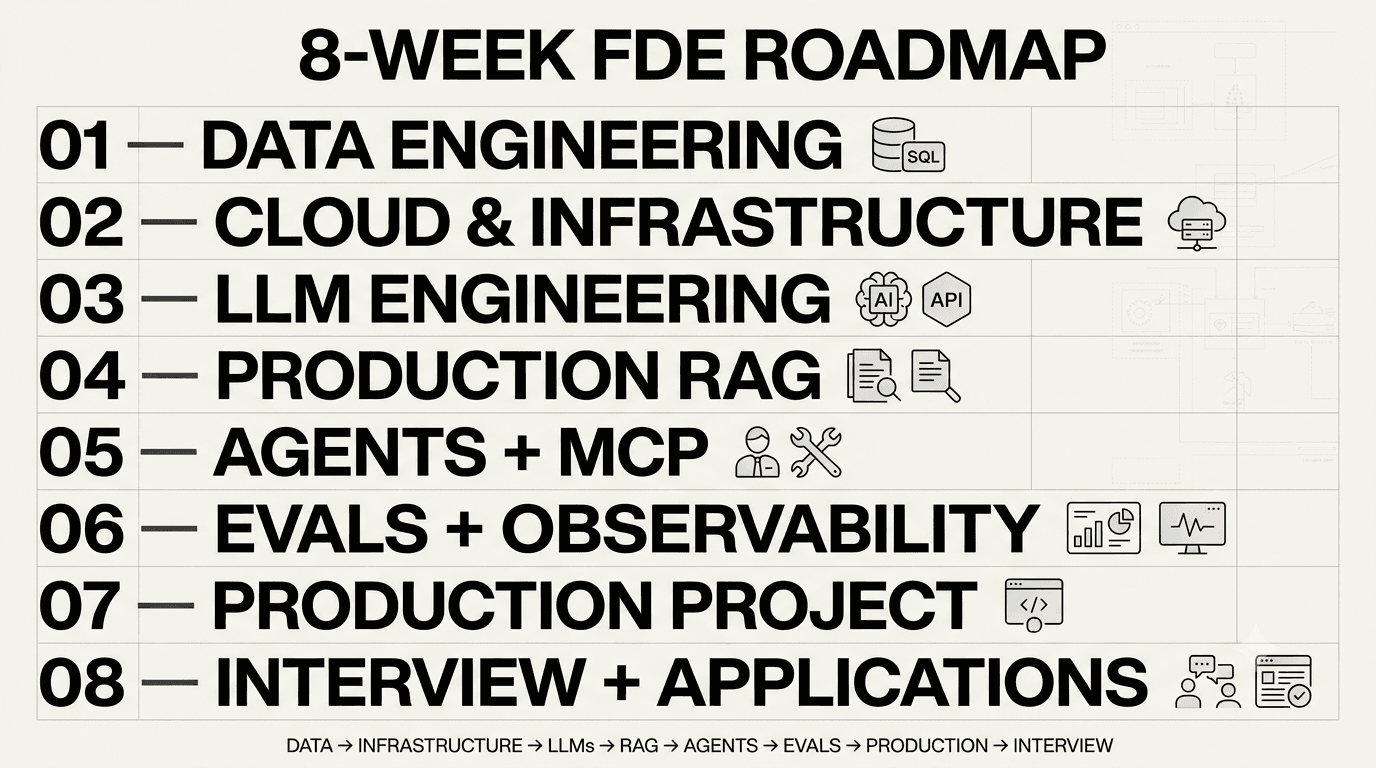
The fastest way to structure FDE preparation is to progress from data and infrastructure fundamentals into LLMs, RAG, agents, evaluation, production deployment and interview preparation.
The sequence is:
Data → Infrastructure → LLMs → RAG → Agents → Evals → Production → Interview
The first six weeks build your engineering foundation.
Weeks seven and eight turn that knowledge into evidence.
Week 1: Data Engineering
Most beginner AI roadmaps start with machine learning or prompt engineering.
For FDE preparation, that's often backwards.
A customer doesn't hand you a beautifully structured dataset and say:
"Please build an AI agent."
You may get:
- CSV files
- SQL databases
- PDFs
- Spreadsheets
- Legacy tables
- Duplicate records
- Missing fields
- Conflicting terminology
Before AI can use that information, you need to understand it.
Learn
- Advanced SQL
- Window functions
- CTEs
- Query optimization
- Query plans
- Data modeling
- Star schemas
- Bronze/Silver/Gold architecture
- dbt
- DuckDB
- Messy-data analysis
The goal isn't simply to learn SQL.
It's to learn how to investigate data.
Your Week 1 Deliverable
Take a messy public dataset and document:
- What the data contains
- What is wrong with it
- How you would model it
- What transformations are required
- What queries an actual customer might need
By the end of the week, you should be able to explain not only what the data says, but why its structure matters to the eventual application.
Week 2: Cloud and Infrastructure
A notebook that works on your laptop is not a production system.
An FDE needs to understand what happens after the demo.
Learn:
- Docker
- Terraform
- Kubernetes fundamentals
- Networking
- IAM
- Secrets management
- Monitoring
- Incident response
- Basic cloud architecture
The mindset should change from:
"It works on my machine."
to:
"Someone else can deploy and operate it."
Your Week 2 Deliverable
Take the application from Week 1 and:
- Containerize it
- Create environment variables
- Add basic logging
- Deploy it
- Document the architecture
You don't need to become a Kubernetes expert in one week.
You need to understand the infrastructure decisions that make an application deployable and maintainable.
Week 3: LLM Engineering
Now introduce the LLM.
But don't spend the entire week learning prompt tricks.
Learn to build applications around models.
Focus on:
- API integration
- Tool calling
- Structured outputs
- Error handling
- Retries
- Authentication
- Streaming
- Production-oriented application design
The skill you're developing isn't:
"I know prompting."
It's:
"I can put an LLM inside a real software system."
Your Week 3 Deliverable
Build an API that:
- Receives a user request
- Calls an LLM
- Uses structured output
- Handles failures
- Logs the request
- Returns a predictable response
The objective is to move from experimenting with models to engineering around models.
Week 4: Production RAG
RAG means Retrieval-Augmented Generation: retrieving relevant information from a knowledge source and providing that context to the model before generating a response.
A toy RAG project might use ten clean documents.
A real customer could have thousands.
Learn
- Document ingestion
- Chunking
- Metadata
- Retrieval
- Vector databases
- Hybrid search
- RAG evaluation
- Enterprise PDF processing
Potential technologies include:
- PostgreSQL + pgvector
- Pinecone
- Weaviate
But don't learn tools simply because they appear in job descriptions.
Understand the architecture first.
Your Week 4 Deliverable
Build a RAG application that can answer questions over messy documents.
Then create a small evaluation dataset.
For example:
Now you're measuring the system.
That's much closer to production engineering.
Week 5: Agents, MCP and Tools
Now add agentic behavior.
But don't add an agent because the word "agent" looks good on LinkedIn.
Ask:
Does this problem actually require autonomous tool use?
Learn:
- Tool calling
- Agent workflows
- MCP
- Sub-agents
- Agent skills
- Multi-step workflows
- Failure handling
- Human approval points
Your Week 5 Deliverable
Take your RAG system and give it tools.
For example, the agent could:
- Search internal documentation
- Retrieve relevant information
- Call a mock customer database
- Generate an answer
- Request human approval before a sensitive action
That demonstrates something much more valuable than a chatbot.
It demonstrates workflow automation.
Week 6: Evals and Observability
This is where many AI projects stop.
Don't.
An FDE needs to prove that the system works and know when it stops working.
Learn:
- Evaluation datasets
- LLM-as-a-judge
- Groundedness
- Answer relevance
- Context relevance
- Tracing
- Monitoring
- Failure analysis
- Regression testing
The RAG Evaluation Triad
Use three basic questions:
1. Groundedness
Is the answer supported by the retrieved information?
2. Answer relevance
Did the system actually answer the user's question?
3. Context relevance
Did retrieval find the right information?
Now your project has a feedback loop.
You can:
Measure → Debug → Improve → Re-test
That is the difference between an AI demo and an engineered AI system.
Week 7: Build One Serious FDE Project
This is the most important week.
Don't build five mini-projects.
Build one complete customer-style system.
Portfolio Project: Enterprise Support Intelligence Platform
Imagine a company with thousands of:
- Product manuals
- Support tickets
- Incident reports
- Internal documentation
- Troubleshooting guides
- Customer FAQs
Support engineers waste time searching across systems.
Your job is to build an AI system that helps them find answers faster.
The Customer Problem
Start with a one-paragraph customer brief:
The customer operates a large technical support organization with information spread across PDFs, internal documentation and structured support data. Engineers spend significant time searching multiple sources to diagnose recurring problems. The goal is to create a secure AI assistant that retrieves the right information, explains the answer with evidence and can perform approved actions through connected tools.
That's your starting point.
You aren't just building an AI assistant.
You're solving a business problem.
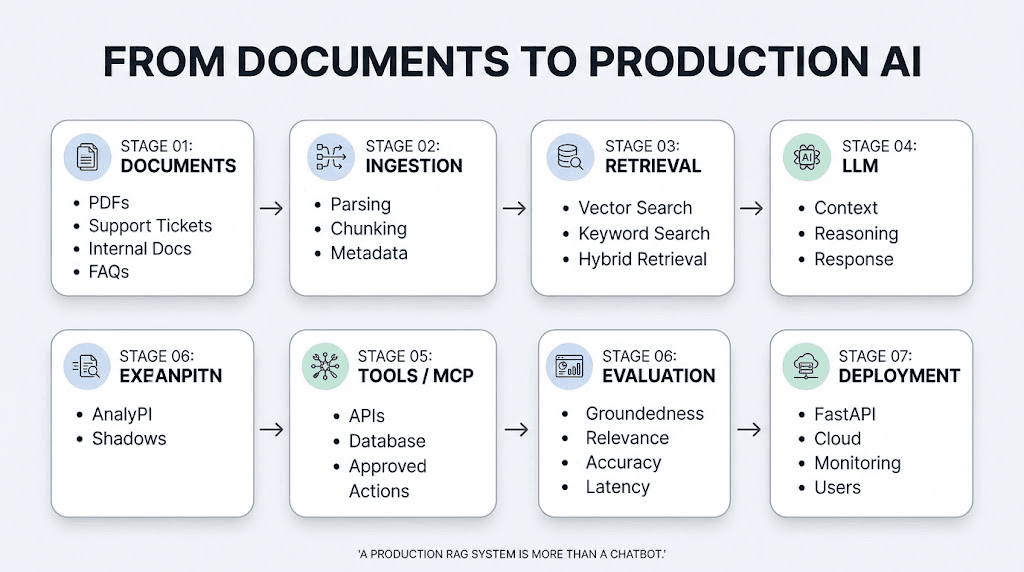
The Architecture
A production-style architecture could look like:
Documents
↓
Ingestion Pipeline
↓
Chunking + Metadata
↓
PostgreSQL / pgvector
↓
Hybrid Retrieval
↓
LLM
↓
Tool Layer / MCP
↓
FastAPI
↓
Web Interface
↓
Evaluation
↓
Observability
↓
Cloud Deployment
This project touches almost every major FDE skill.
Recommended Technology Stack
Backend
Python + FastAPI
Database
PostgreSQL + pgvector
AI
LLM API
Retrieval
Vector search + keyword/hybrid retrieval
Agent Layer
Tool calling + MCP
Infrastructure
Docker + Terraform
Frontend
React or a simple production-style web interface
Evaluation
OpenAI Evals, promptfoo or another evaluation framework
Observability
Tracing + application logging + evaluation dashboard
You don't need every AI tool in existence.
The goal is to demonstrate that you understand how the pieces fit together.
What Your Portfolio Project Must Demonstrate
By the end, someone reviewing your GitHub repository should be able to see:
- A real business problem
- Architecture diagram
- Data pipeline
- Database schema
- RAG implementation
- Agent/tool workflow
- MCP integration where appropriate
- Evaluation methodology
- Deployment configuration
- Monitoring
- Security considerations
- Technical documentation
- Measurable outcome
One serious deployed project is more valuable than a collection of disconnected tutorials because it demonstrates integration.
Don't Forget the Consultant Layer
This is where technically strong candidates can lose.
You need to explain your work like an FDE.
Create three documents.
1. Site Survey
Explain:
- Customer environment
- Existing systems
- Data sources
- Constraints
- Stakeholders
- Risks
2. Technical Scoping Document
Explain:
- Problem
- Proposed architecture
- APIs
- Data flow
- Security
- Costs
- Success criteria
- Deployment plan
3. Executive Summary
Explain the entire project in one page.
No technical overload.
Answer:
What was wrong?
What did we build?
What changed?
What did it cost?
How did we measure success?
This is the difference between saying:
"I built a RAG application."
and saying:
"I identified a workflow problem, designed a solution, built it, deployed it, evaluated it and measured its impact."
That second answer sounds much more like an FDE.
Your Result Needs a Number
This is one of the most important FDE habits.
Don't say:
"I built an AI support assistant."
Say something measurable if you actually measured it.
For example:
"Built a support RAG system and reduced average document-search time from X minutes to Y minutes in a controlled test."
Or:
"Achieved X% answer accuracy across a test set of Y questions."
Don't invent the number.
Measure it.
A measured result gives you something concrete to discuss in an interview.
Week 8: Prepare for the FDE Interview
FDE interviews aren't necessarily traditional software engineering interviews.
You should expect some combination of:
- Debugging
- System design
- Technical problem solving
- Ambiguous customer scenarios
- Architecture discussions
- Communication
- Production reasoning
Current FDE roles increasingly emphasize end-to-end ownership, so prepare for more than coding questions.
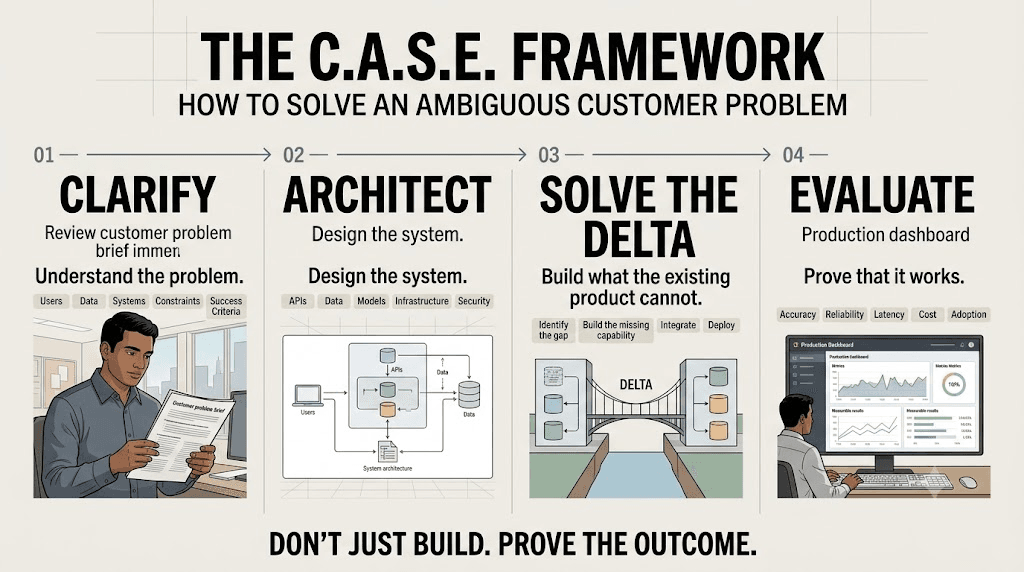
The C.A.S.E. Framework
When an interviewer gives you an ambiguous customer problem, don't immediately start coding.
Use:
C.A.S.E.
C — Clarify
Ask:
- What is the actual problem?
- How many users?
- How much data?
- What systems exist?
- What does success mean?
- Is sensitive data involved?
- What are the security constraints?
Don't assume.
Clarify.
A — Architect
Draw the system.
Explain:
- Data sources
- APIs
- Storage
- Retrieval
- Model
- Tools
- User interface
- Monitoring
Show how the pieces connect.
S — Solve the Delta
Ask:
What can the existing product already do?
Then:
What does it not do?
That's the Delta.
Explain the engineering work required to close it.
E — Evaluate
Finally ask:
How will we know the system works?
Discuss:
- Accuracy
- Groundedness
- Latency
- Cost
- Reliability
- Security
- User adoption
- Monitoring
A junior answer may focus mostly on Python.
A stronger FDE answer considers:
Architecture + Security + Cost + Reliability + Customer Impact
Expect Ambiguous Problems
FDE interviews can involve problems that don't have a neat coding-test answer.
Imagine:
A customer has several petabytes of data on-premises and needs to begin using an AI system immediately.
The question isn't simply:
"What cloud service do you use?"
You need to reason about:
- Bandwidth
- Data transfer
- Security
- Schema
- Storage
- Cost
- Access controls
- Migration strategy
- Timeline
- What can be built while migration happens
That's FDE thinking.
The best solution isn't always the most technically elegant one.
It's the one that solves the customer's actual constraint.
How to Get the FDE Interview
A strong project doesn't guarantee an interview.
You still need distribution.
The goal isn't to send hundreds of generic applications.
Instead, build a focused list of companies hiring for:
- Forward Deployed Engineer
- Forward Deployed Software Engineer
- Applied AI Engineer
- Technical Deployment Engineer
- Customer-facing AI engineering roles
Research the actual job description before applying.
Pay attention to:
- Required engineering skills
- Customer interaction
- Deployment expectations
- Cloud requirements
- AI requirements
- Experience requirements
- Location requirements
Don't Send Only a Resume
Your outreach should make the person curious about your work.
Instead of:
"Hi, I'm interested in FDE opportunities. Please find my resume attached."
Lead with the project.
For example:
"I built and deployed an AI support system that ingests enterprise-style documents, uses hybrid retrieval, exposes tools through MCP and evaluates answer quality. Here's a two-minute walkthrough."
Now there's something to investigate.
The resume becomes supporting evidence.
The project becomes the conversation starter.
The 8-Week Roadmap at a Glance
The complete sequence is:
Data → Infrastructure → LLMs → RAG → Agents → Evals → Production → Interview
What You Should Have After 8 Weeks
Don't measure your progress by the number of certificates you've collected.
Measure it by what you can demonstrate.
By the end, you should ideally have:
Technical Skills
- Advanced SQL
- Data modeling
- Docker
- Cloud fundamentals
- Terraform fundamentals
- LLM APIs
- RAG
- Vector search
- Hybrid retrieval
- Agents
- Tool calling
- MCP
- Evals
- Observability
Production Skills
- A deployed application
- Authentication/security considerations
- Logging
- Monitoring
- Evaluation dataset
- Error handling
- Documentation
FDE Skills
- Site survey
- Technical scoping document
- Executive summary
- Architecture diagram
- Measurable success criteria
- Customer-style problem statement
- Two-minute project demo
That's the portfolio.
Not eight certificates.
The Biggest Mistake: Learning Everything Without Shipping
This is where most roadmaps go wrong.
Someone spends:
- Two weeks learning RAG
- One week learning LangChain
- One week learning agents
- One week watching cloud tutorials
- One week watching system-design videos
Then they have a GitHub account containing ten unfinished repositories.
That's not an FDE portfolio.
An FDE needs to demonstrate integration.
The value is in connecting the pieces.
A customer doesn't care that you completed a course on Docker.
They care whether you can deploy the system.
They don't care that you know what RAG stands for.
They care whether the system can reliably retrieve the right information.
They don't care that you know MCP exists.
They care whether you can use tools safely and appropriately.
The Credential Question
Credentials can support your profile, particularly when they align with the architecture and technologies used by the companies you're targeting.
For example, relevant AI architecture credentials may cover areas such as:
- Agentic architecture
- Tool design
- Prompt engineering
- MCP
- Context management
- AI application development
But the broader lesson is more important:
Don't collect certifications instead of building.
If you have limited time, prioritize:
Project → Deployment → Evaluation → Technical Documentation → Interview Practice → Certification
A credential can support your profile.
A working system gives you something to talk about.
What Current FDE Hiring Tells Us
There is a broader shift happening.
The job is moving beyond simply:
"Build software for customers."
Modern FDE teams are increasingly being asked to:
Discover → Build → Deploy → Evaluate → Learn → Improve
That creates a feedback loop between customer problems and product development.
The skill profile therefore goes beyond coding.
You need to be technical enough to build.
You need enough product sense to recognize what should be built.
And you need enough communication ability to convince a customer that the solution is worth using.
That combination is what makes Forward Deployed Engineering different from traditional software engineering roles.
Is FDE the Right Career for You?
An FDE role may suit you if you enjoy:
- Building things quickly
- Working with ambiguous problems
- Talking to customers
- Debugging unfamiliar systems
- Learning new technologies
- Deploying software
- Explaining technical concepts
- Moving between different projects
- Seeing your work used immediately
It may be less attractive if you strongly prefer:
- Long-term ownership of one product
- Minimal customer interaction
- Highly predictable requirements
- Pure research
- Deep specialization in one technical area
Neither path is better.
They're different.
Research Methodology
This roadmap was developed by analyzing current Forward Deployed Engineer and related deployment-oriented hiring signals from leading AI and technology companies, including OpenAI, Anthropic, Palantir and AWS, alongside the engineering skills required to build and deploy modern AI applications.
Because FDE job requirements and open positions change frequently, candidates should re-check the relevant company's official careers page and the specific job description before making career decisions.
The roadmap focuses on recurring engineering themes rather than claiming that every FDE role has identical requirements.
The Bottom Line
The most important thing to understand about Forward Deployed Engineering is that it isn't simply a new name for software engineering.
And it isn't consulting with some AI vocabulary sprinkled on top.
It's the intersection of:
Engineering + Data + AI + Infrastructure + Customers
The strongest FDE candidates can walk into an unfamiliar environment and figure out what matters.
They can understand the data.
They can design the architecture.
They can write the code.
They can deploy the system.
They can evaluate whether it works.
And they can explain the result to someone who doesn't care about the technology but absolutely cares about the outcome.
That's the real skill.
The title may keep changing.
The frameworks will definitely keep changing.
But the underlying job remains surprisingly simple:
Find the Delta. Build what is missing. Put it into production. Prove that it works.
That's what the eight weeks are really preparing you to do.
Frequently Asked Questions
What does a Forward Deployed Engineer do?
A Forward Deployed Engineer builds and deploys technical solutions inside customer environments. The role combines software engineering with data, infrastructure, AI systems, technical discovery and customer problem-solving.
How do I become a Forward Deployed Engineer?
Build strong software engineering fundamentals, learn data and cloud infrastructure, develop production AI skills, learn RAG and agents, understand evaluation and observability, and demonstrate those skills through a deployed customer-style project. This roadmap organizes that preparation into eight weeks.
What skills does an FDE need?
A Forward Deployed Engineer typically needs software engineering, data engineering, cloud infrastructure, LLM application development, RAG, tool use, evaluation, observability, system design and customer communication skills. The exact combination varies by company and specialization.
Is FDE the same as a Solutions Engineer?
olutions Engineer roles can focus more heavily on technical demonstrations, solution design and pre-sales. A technical FDE typically has deeper responsibility for building, integrating and deploying production systems. However, individual companies can define these titles differently, so always read the actual job description.
Is FDE the same as an AI Product Manager?
No. An FDE roadmap is fundamentally engineering-first. While product thinking and customer understanding are important, the FDE is expected to participate directly in technical implementation and deployment.
Do FDEs need to know cloud?
Yes. Deployment and infrastructure are central to the role, particularly when working inside customer environments. You don't necessarily need to be a cloud architect on day one, but you should understand: Networking IAM Containers Secrets Deployment Monitoring Basic cloud architecture
Should I learn RAG before agents?
For this roadmap, yes. RAG comes before agents because understanding data, retrieval and context provides a stronger foundation for building more complex AI workflows. Agents should solve a real workflow problem rather than simply being added for complexity.
Do FDE interviews use LeetCode?
Interview formats vary by company. FDE preparation should therefore not revolve exclusively around LeetCode. You should also practice: Debugging System design Architecture Ambiguous technical problems Customer scenarios Production trade-offs Communication
What should an FDE portfolio project include?
A strong FDE portfolio project should demonstrate data ingestion, retrieval, LLM integration, tools or agents, evaluation, deployment, monitoring, documentation and measurable results. It should also explain the customer problem and why the architecture solves it.
Is eight weeks enough to become an FDE?
Eight weeks is enough to follow a focused FDE preparation plan, but it is not a guarantee of qualification or employment. Experience requirements differ substantially by company and role. For someone starting from scratch, the eight weeks should be viewed as an intensive roadmap for building the required foundation and portfolio evidence—not as a guaranteed shortcut into an FDE position.
The HotJPT editorial team covers AI, US immigration, IT job market trends, and staffing intelligence for recruiters, bench sales marketers, and IT consultants.