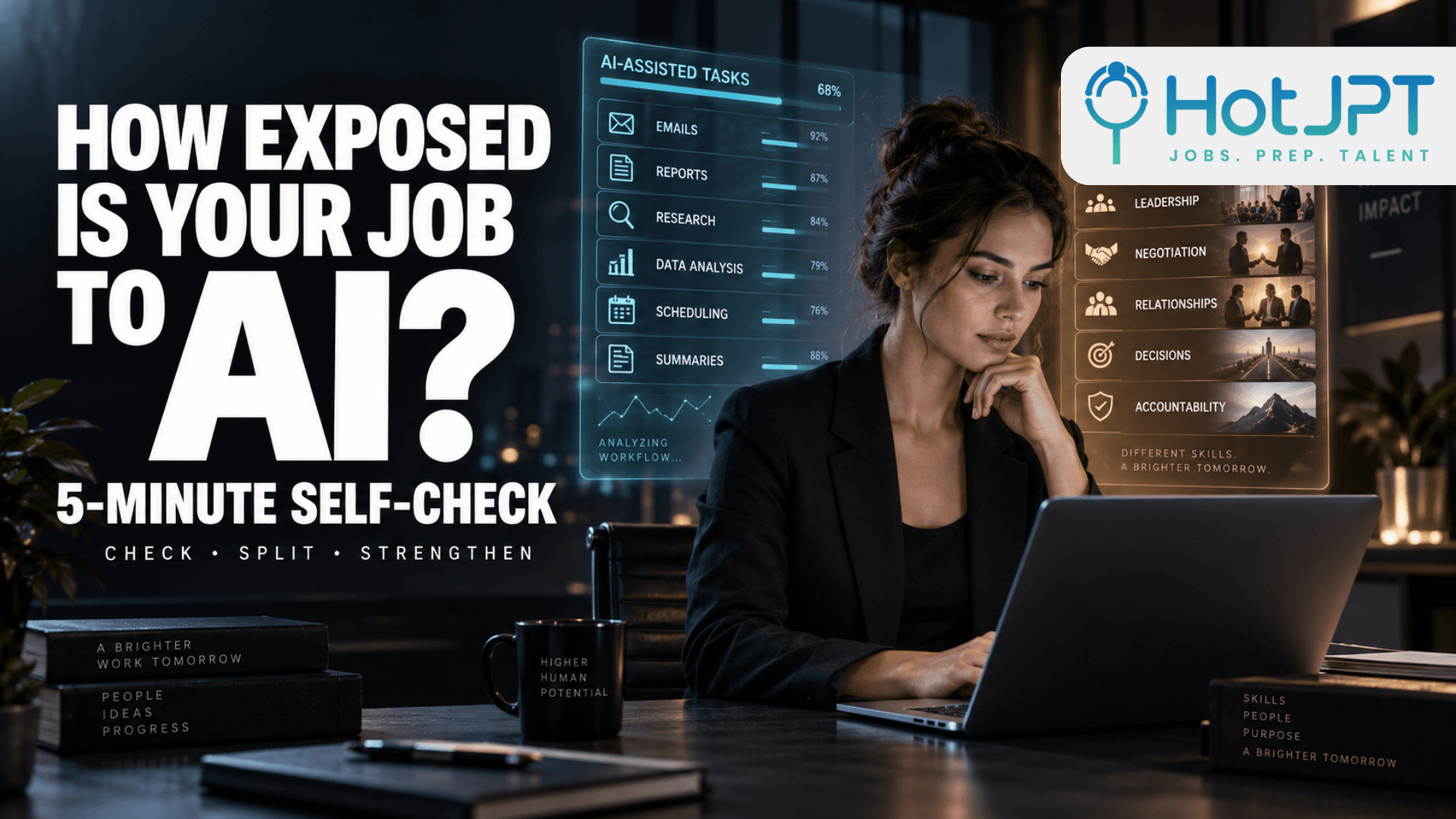
Some jobs we traditionally consider highly skilled are also highly exposed to AI.
Accountants, analysts, project managers, and customer service workers all perform tasks AI can increasingly assist with.
But AI exposure does not mean your job will disappear. The better question is: Which parts of your job are changing first?
Problem: AI does not affect every part of a job equally, so job titles are misleading.
Framework: The 3 step AI Job Exposure Self-Check.
Payoff: See what AI can assist with, where your human value remains, and which skill to strengthen next.
The AI Job Exposure Self-Check at a Glance
What does AI exposure actually mean?
Fact: Andrej Karpathy's US Job Market Visualizer analyzes 342 occupations covering about 143 million US jobs, based on BLS data. Code is open on GitHub.
Each occupation receives an AI exposure score from 0 to 10. The score estimates how much current digital AI could reshape the work through automation or productivity boost.
That distinction matters. A score of 9 does not mean a 90% chance the job will disappear.
Reported claim: Karpathy describes the scores as rough AI generated estimates rather than rigorous forecasts of job losses. High exposure means AI could change how the work gets done.
Worth knowing: When the tool first went viral, Karpathy briefly took it offline. He noted it had been "wildly misinterpreted." His clarification:
"The 'exposure' was scored by an LLM based on how digital the job is. This has no bearing on what actually happens to these occupations, which has to do with demand elasticity and a lot more."
The tool is back up. Treat the scores as a rough exploratory signal, not a verdict.
What do the job scores show?
The contrast between digital and physical work is noticeable.
Customer service scores 9/10 because much of the work is answering questions and processing digital information.
Accountants score 8/10. Their work includes analysis, reporting, and compliance. These are processes AI can increasingly support.
Management analysts and project managers score 7/10. Their roles include analysis, scheduling, documentation, and monitoring.
Carpenters score 2/10 because the core work requires physical presence and real-time problem solving.
HotJPT interpretation: The pattern is not "office jobs are unsafe." Jobs built around digital information contain more tasks AI can assist with today.
Step 1: Check What You Actually Do
Do not begin with your job title. Start with daily tasks.
Check what you do regularly:
☐ Writing emails, reports, or documents
☐ Researching information
☐ Summarizing information
☐ Entering or organizing data
☐ Creating presentations
☐ Scheduling or coordinating work
☐ Answering customer questions
☐ Analysing spreadsheets
☐ Preparing reports
☐ Writing or reviewing code
☐ Searching through large amounts of information
Ready-to-Use: Copy-paste audit prompt
Run this in ChatGPT or Claude:
Act as my AI Job Exposure Auditor. I am a [YOUR JOB TITLE]. My top 5 daily tasks are: 1), 2), 3), 4), 5). For each task, rate AI assistance as High / Medium / Low and explain why. Then list 2 tasks to delegate to AI this week and 2 tasks that are my human edge. Return as a table.
Mock output example:
Your action: List 3 frequent tasks and run the prompt above.
Step 2: Separate AI Assistance From Human Value
Now split your work.
The goal is not to prove humans are better. It is to see where your contribution is different.
AI might prepare a project summary. A project manager still needs to resolve conflict and own the outcome when plans change.
AI might analyse financial data. An accountant still needs to interpret exceptions and advise clients.
Your action: Complete these sentences:
AI can help me with: ____
My human edge is: ____
Step 3: Choose What to Strengthen Next
Do not spend all energy protecting tasks AI can help with. Use AI for those tasks.
Then strengthen the skills that increase value around the technology.
Ask:
- Which repetitive task could AI help with today?
- Which tasks still need my judgment?
- Where do relationships matter?
- What decisions am I responsible for?
- Which one skill makes me more valuable next year?
Choose one skill, not ten. That is your next priority.
The HotJPT Take: From Task Value to Leverage Value
The wrong question is "Which careers are safe?"
When admin tasks approach zero marginal cost, organizations do not need less work. They need more leverage from human work.
Compensation migrates. It moves from "I can do the task" to "I am responsible for what happens after the task."
Judgment, negotiation, and accountability are not soft skills here. They are where value is captured in an AI workflow.
Build your value where you own the consequence.
Save This: The 3-Question Career Check
Whenever AI headlines spike, ask:
If AI can do 30% of your work, how will you make the remaining 70% 3x more valuable?
Shareable Takeaway
Don't ask only whether AI can replace your job. Ask which parts AI can handle, and where you still create unique value.
Sources:
Andrej Karpathy Visualizer: https://karpathy.ai/jobs/
GitHub Methodology: https://github.com/karpathy/jobs
The HotJPT editorial team covers AI, US immigration, IT job market trends, and staffing intelligence for recruiters, bench sales marketers, and IT consultants.