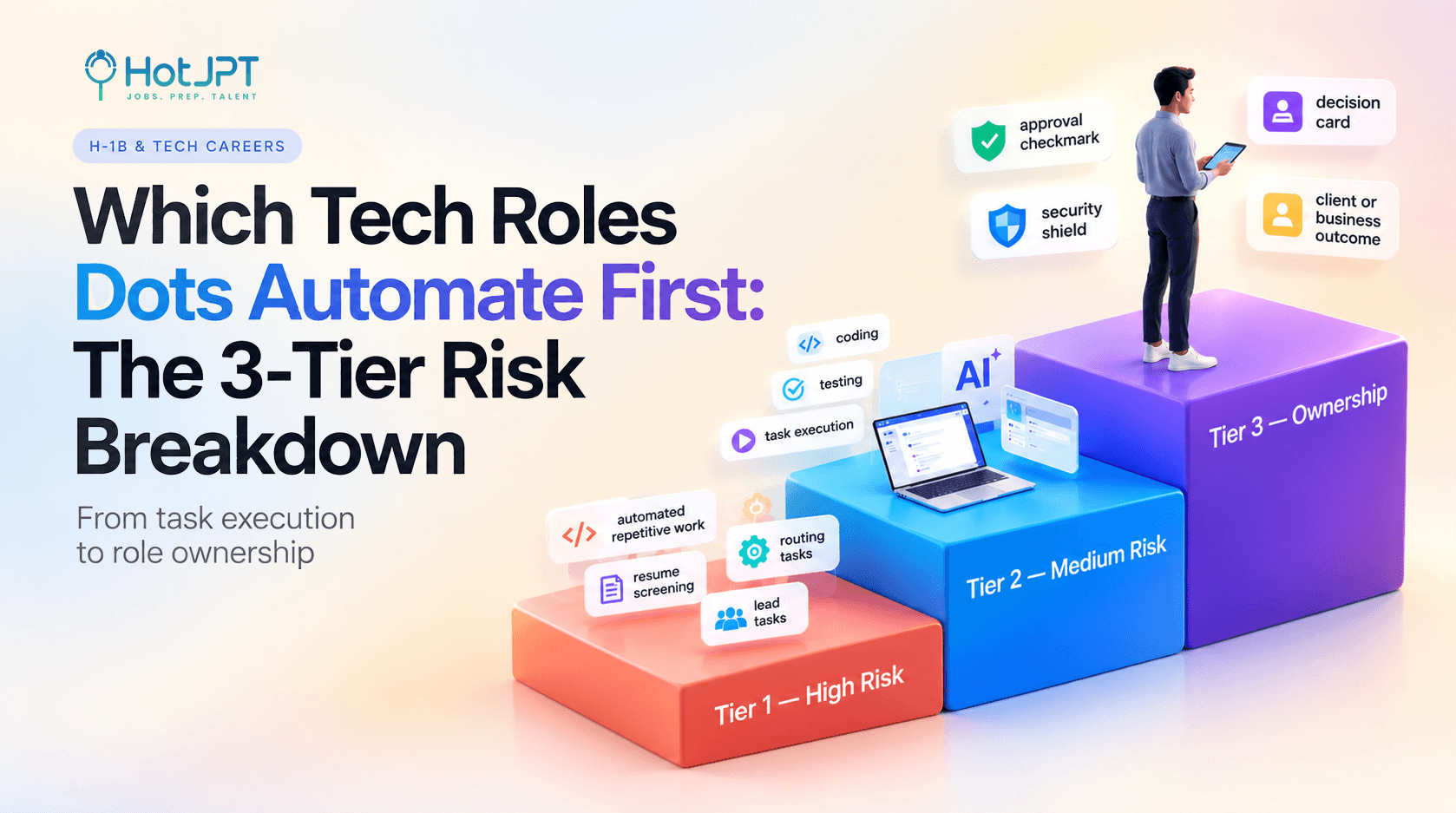
AI Is Changing What Junior Developers Need to Learn
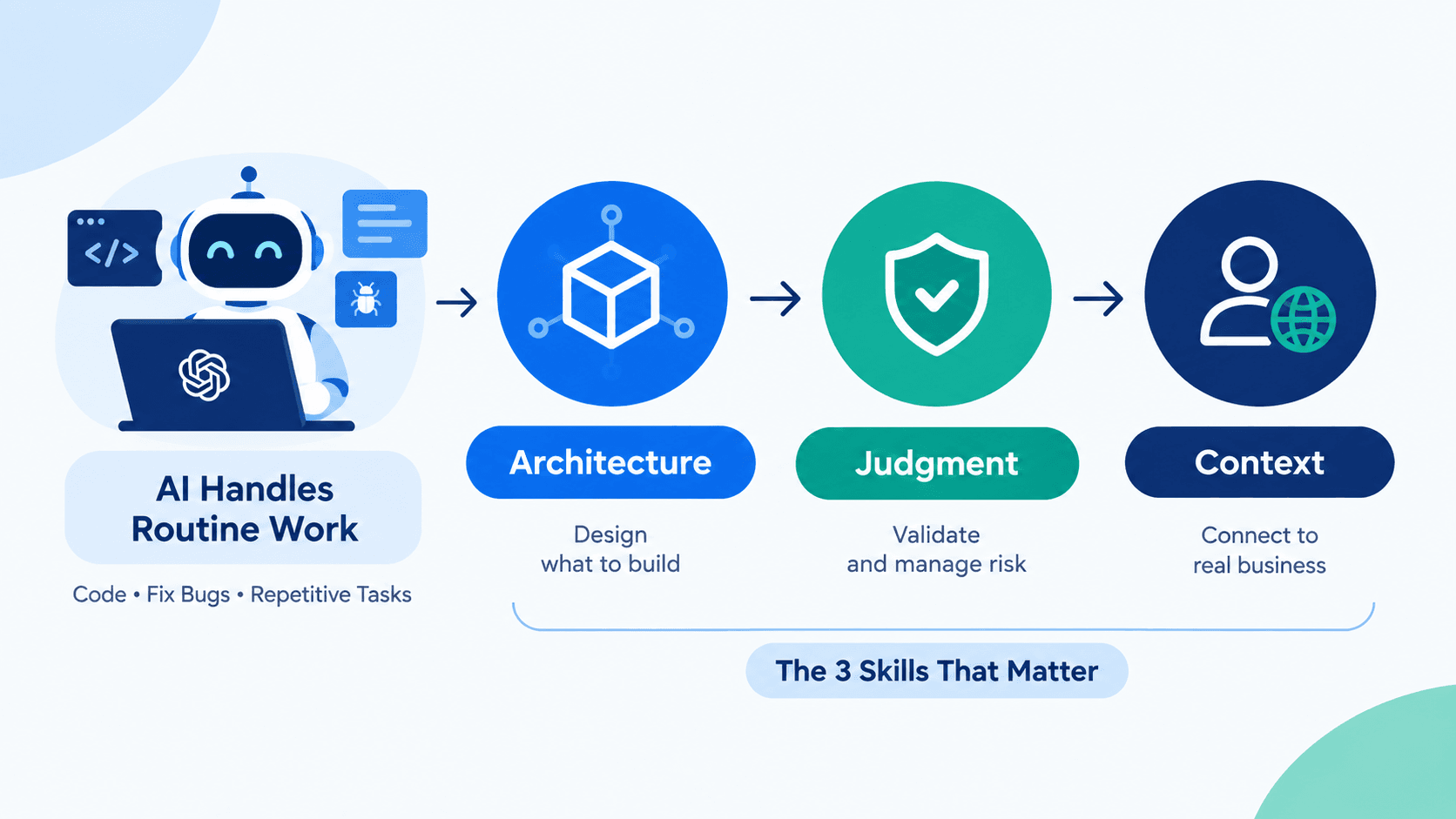
AI is getting better at the work junior developers traditionally used to build experience: writing routine code, fixing common bugs, and handling repetitive development tasks.
The U.S. software market is still projected to grow. But as AI takes on more implementation work, the skills that demonstrate engineering value are changing.
Problem: AI can increasingly automate routine coding work.
Framework: Build three skills around AI : Architecture, Judgment, and Context.
Payoff: Don't compete with AI at writing code. Learn to decide what should be built, validate what AI produces, and connect technology to real business problems.
The 3 Skills AI-Native Developers Need
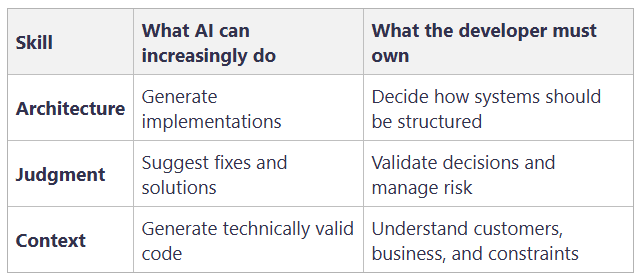
The shift is simple:
AI increasingly handles implementation. Developers need to own the decisions around it.
Why Is This Changing Now?
AI coding is moving beyond simple autocomplete.
Anthropic analyzed 500,000 coding interactions across Claude.ai and Claude Code. It found that 79% of Claude Code conversations involved automation, compared with 49% for Claude.ai.
OpenAI describes GPT-6 Astra as capable across software engineering, computer use, browsing, and professional workflows. Its launch materials position it for complex, multi-step work rather than simple code generation.
These developments do not prove that developers are becoming unnecessary.
They do show that more implementation work can increasingly be delegated to AI.
That changes the career question from:
“Can you write the code?”
to:
“Can you make the right engineering decisions around the code?”
1. Architecture: Know Where the Code Belongs
Architecture is deciding where the code belongs and how the system should work.
AI can generate an API, database model, authentication flow, or service implementation. But it does not automatically know whether that design fits your company's infrastructure.
Imagine building a new e-commerce application.
AI can generate a checkout service quickly. An engineer still needs to decide how payments, inventory, authentication, databases, queues, and failure handling should interact.
Those decisions affect scalability, security, cost, and reliability.
As implementation becomes easier, understanding the system around the implementation becomes more important.
Copy-Paste Architecture Checklist
Before accepting an AI-generated design, ask:
- Where does this component belong?
- What dependencies does it create?
- How does it fail?
- How does it scale?
- What security risks exist?
- How will we monitor it?
2. Judgment: Know Whether the Answer Is Right
AI can produce an answer without making the answer correct.
That matters most when software affects production systems.
Imagine an application fails at 2 AM.
An AI agent can inspect logs, identify possible causes, suggest commands, and generate a patch. The engineer still needs to decide whether the diagnosis is reliable.
The wrong fix could increase downtime or create a larger incident.
That makes critical evaluation part of the developer's job.
AI-generated code can contain security issues, incorrect assumptions, inefficient queries, compatibility problems, or faulty business logic.
Copy-Paste AI Review Prompt
Review this implementation like a production engineer.
Identify incorrect assumptions, security risks, scalability problems, failure scenarios, hidden dependencies, and business-logic errors.
Do not rewrite the code until you explain each risk and its severity.
3. Context: Know What Should Actually Be Built
Context is knowing what should actually be built and why.
The same technical solution can be appropriate for one company and completely wrong for another.
Healthcare software may involve sensitive data, regulatory requirements, and strict workflows.
A financial application may prioritize transaction integrity, fraud controls, auditability, and latency.
The programming language might be identical.
The engineering decisions are not.
Technical capability matters, but understanding the customer, business environment, and operational constraints determines whether the solution actually works.
Copy-Paste Context Checklist
User: Who uses this?
Problem: What are they trying to solve?
Constraint: What cannot change?
Risk: What could go wrong?
Success: What measurable outcome defines a good solution?
What Does the U.S. Job Market Show?
The data does not support the claim that software developers are simply disappearing.
The U.S. Bureau of Labor Statistics projects software-developer employment to grow 10% from 2025 to 2035, with about 174,700 additional software-developer jobs during that period.
At the same time, BLS projects computer programmer employment to decline 7% from 2025 to 2035. It specifically notes that companies are expected to use AI and other technologies to automate repetitive programming tasks.
These figures point to an important distinction.
The broader software-development profession can continue growing while some routine programming work becomes increasingly automated.
For junior developers, that could mean the entry-level bar moves upward.
What Should Junior Developers Learn?
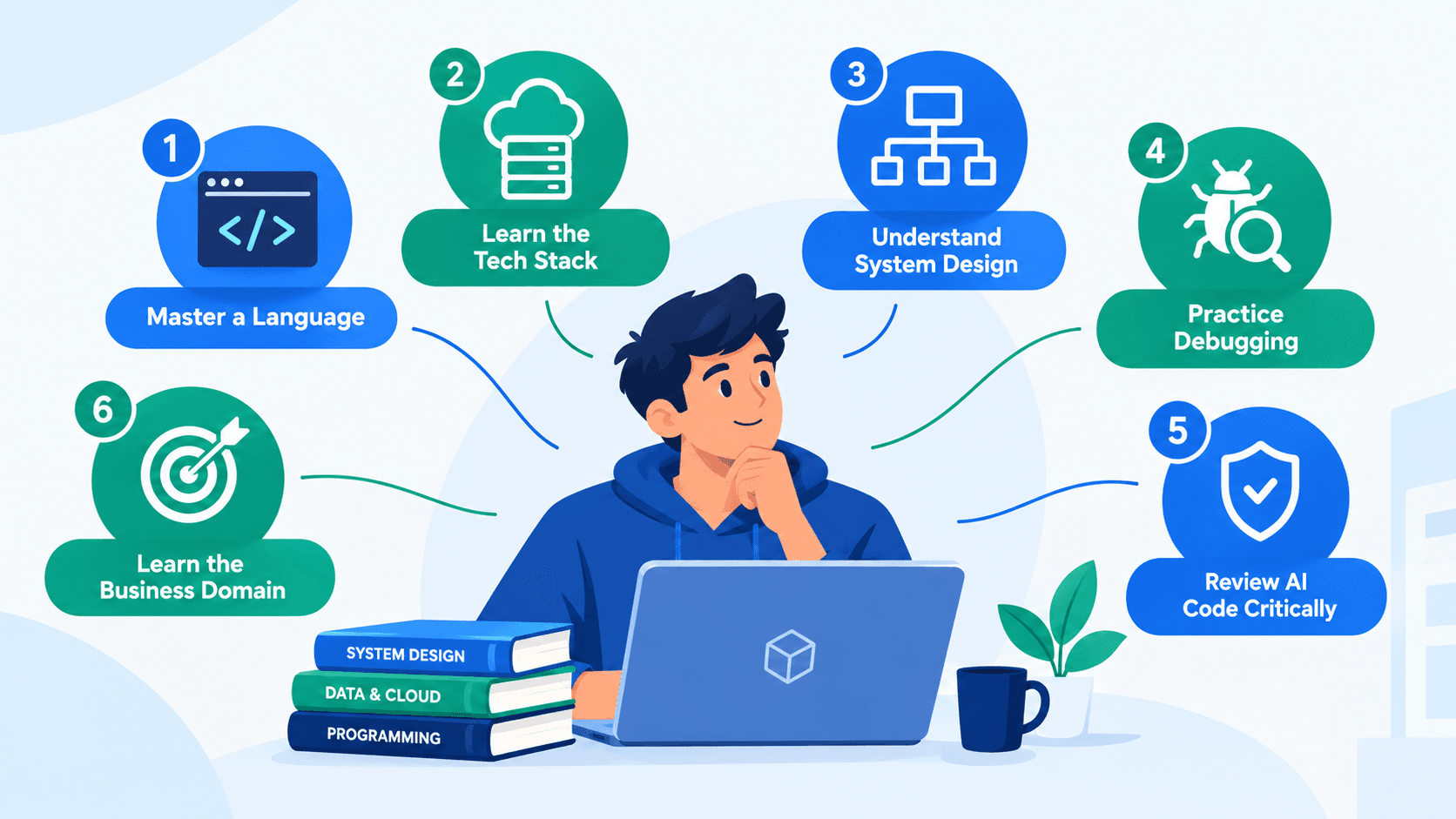
The answer is not to stop learning programming.
Programming fundamentals become more valuable when you need to understand, review, debug, test, and improve machine-generated code.
Focus on six areas:
- Master one programming language.
- Understand APIs, databases, networking, and cloud systems.
- Learn basic system design.
- Practice debugging production-style problems.
- Learn to review AI-generated code critically.
- Build knowledge in a specific business domain.
Then use AI throughout the engineering workflow:
Requirement → Architecture → AI-Assisted Implementation → Testing → Debugging → Deployment → Monitoring
The goal is not to let AI make every decision.
The goal is to make AI dramatically more useful because you understand the decisions around the code.
HotJPT Take
Routine implementation may become less differentiated as AI coding systems become more capable.
That makes architecture, judgment, and context important areas for junior developers to develop alongside their programming skills.
There is a difference between saying:
“I can write an API.”
and:
“I can identify the right API, design its architecture, use AI to build it, validate it, and own it in production.”
The second demonstrates a broader engineering capability.
Save This: The AI-Native Developer Checklist
Before building
☐ Understand the business problem
☐ Define the user and constraints
☐ Choose the architecture
☐ Identify security and failure risks
While building
☐ Use AI for implementation
☐ Review important decisions
☐ Test edge cases
☐ Validate AI-generated code
Before shipping
☐ Check performance
☐ Check security
☐ Check observability
☐ Confirm business requirements
☐ Know how to roll back
The Formula
Developer value = Technical Skill + Architecture + Judgment + Context + AI Leverage
The tools will keep changing.
The ability to make sound engineering decisions is what you should keep building.
AI may write more of the code, but engineers still have to decide what the code should accomplish.
Frequently Asked Questions
Will AI eliminate junior developer jobs by 2027?
There is no reliable evidence in this source supporting that blanket prediction. BLS currently projects software-developer employment to grow through 2035.
Should junior developers still learn coding?
Yes. Programming knowledge is essential for reviewing, debugging, testing, and improving AI-generated software.
Should I learn more frameworks to stay competitive?
Focus first on fundamentals, system design, debugging, and AI-assisted development. Framework knowledge should support those capabilities.
What should I learn alongside AI coding tools?
Build strength in architecture, judgment, and business context. These skills help you evaluate what AI produces rather than simply accepting it.
The HotJPT editorial team covers AI, US immigration, IT job market trends, and staffing intelligence for recruiters, bench sales marketers, and IT consultants.