Tech Is Laying People Off. So Why Is It Still Hiring?
What is actually happening to the tech job market in 2026?
Tech companies have announced roughly 149,000 layoffs so far in 2026, up 67% from last year, while simultaneously leading every other industry in announced hiring plans, at over 17,000. The two numbers aren't contradictory: employers are cutting traditional software and IT roles while hiring aggressively for AI-adjacent skills. The labor market isn't shrinking or booming; it's reallocating, and the deciding factor for any individual worker is whether their skill stack is moving with it.
That's the paradox in one paragraph. Now let's take it apart properly.
Tech companies fired thousands of people this year. They also announced thousands of new hires. Both statements are true. And that's exactly what makes this job market so confusing to read from the outside.
Through July 2026, technology employers announced 149,023 job cuts, a 67% jump from the same point last year, and enough to make tech the single biggest source of layoffs in the U.S. economy this year, responsible for roughly 31% of all cuts tracked by Challenger, Gray & Christmas. At the same time, tech also leads every other industry in announced hiring plans for the year, at 17,231, ahead of automotive, aerospace, and every other sector Challenger tracks.
So which is it? Is tech shedding workers or building teams?
It's both, because the two numbers aren't measuring the same jobs. Companies aren't simply replacing every position they eliminate with an identical one. They're cutting a specific kind of role, often the repetitive, well-defined, easily-scoped kind, while hiring for a different kind of role that didn't exist at the same scale two years ago.
Call it the Great Tech Skill Reallocation: the unit of disruption in this cycle isn't the occupation. It's the skill.
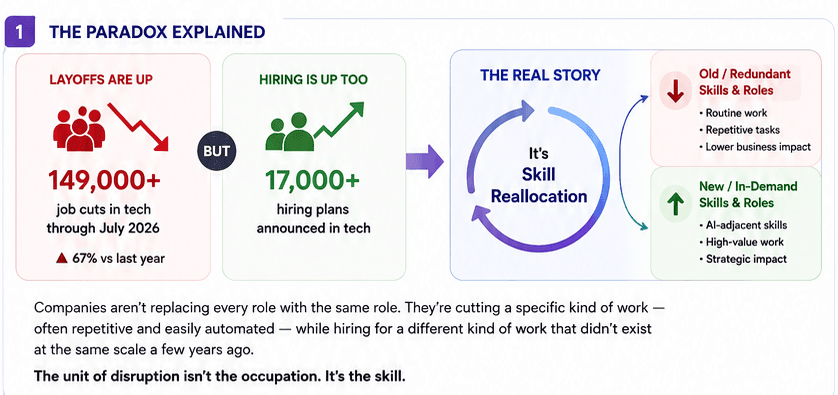
Diagram 1. The tech hiring paradox: layoffs and hiring can rise at the same time when companies are reallocating skills.
Layoffs Down Everywhere Except Tech
That's the part of the picture the original headlines usually miss. Across the whole U.S. economy, 2026 layoffs are actually falling. July's total of 33,429 was the lowest monthly figure in two years, and year-to-date cuts are down 41% from 2025. Tech is the exception, not the rule: it's the one sector still cutting hard while everything else cools off. Employers cited artificial intelligence as the reason behind roughly a quarter of all 2026 layoffs.
Hiring Is Quietly Climbing Back Too
Software development job postings on Indeed sit at about 74-75% of their pre-pandemic level as of August 2026, still deeply depressed, but recovering from a low point of around 61% in mid-2025. And the shape of that recovery is telling: 71% of the increase in software postings over the past year came from senior roles, and more than a third of that increase came from postings that mention AI directly in the job title. This isn't a return to how software hiring worked in 2021. It's a narrower, more skill-specific rebound.
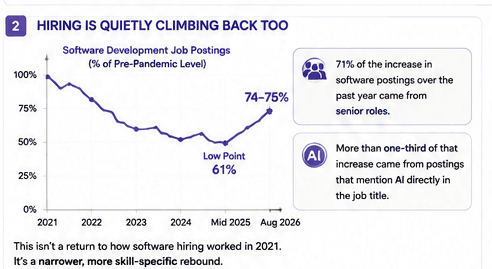
Diagram 2. Software-development postings are recovering from their 2025 low, with the rebound concentrated in senior and AI-linked roles.
AI-Tagged Postings Are Still a Minority, But a Fast-Growing One
As of mid-2026, roughly 5.9% of all U.S. job postings on Indeed reference AI or generative AI skills, up from a prior peak of just 3.3% in 2022. CompTIA counted more than 275,000 active U.S. postings referencing some level of AI skill in January 2026 alone, and dedicated AI roles, including AI engineers and AI architects, grew 81% year-over-year, even though they remain a small slice of total tech hiring.
Job Openings Still Outnumber Hires Nationally
BLS JOLTS data for June 2026 shows 7.4 million open positions against 5.3 million actual hires that month, a gap that shows up across the economy, not just tech, and reflects a market where employers are open to hiring but selective about who gets the offer.
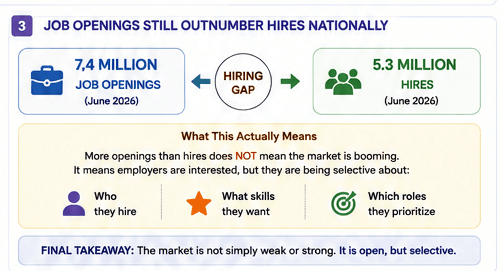
Diagram 3. The gap between job openings and actual hires points to an open but selective market.
Put together, none of this describes a dying industry. It describes an industry mid-renovation.
Which Roles Are Actually Being Redesigned?
Based on posting-level demand rather than guesswork, the clearest shifts are happening in: traditional software development moving toward AI-assisted development; traditional data analytics moving toward AI-assisted analytics and AI infrastructure; traditional QA moving toward automated and AI-assisted quality engineering; traditional DevOps moving toward AI-enabled platform engineering; and traditional cybersecurity moving toward AI-augmented threat detection. None of these occupations are disappearing. Their center of gravity is shifting.
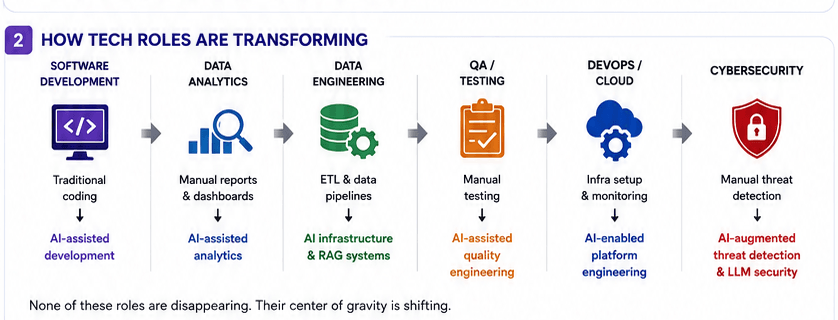
Diagram 4. The center of gravity is shifting inside major tech roles rather than the occupations disappearing outright.
If You Have One of These 10 Tech Jobs, Here's What I'd Add to Your Stack
This is the part worth screenshotting.
| Role | Signal / Risk / Lift | Skills |
| Java Developer | Stable / Moderate / High | Spring AI, RAG, vector DBs, MCP |
| .NET Developer | Stable / Moderate / High | Semantic Kernel, Azure AI Search, RAG |
| Data Analyst | Very Strong / High / Very High | AI-assisted BI, Python automation |
| Data Engineer | Very Strong / Low–Mod. / Very High | Vector pipelines, RAG infra, AI observability |
| Full-Stack Developer | Stable / Moderate / High | AI feature integration, RAG backend |
| QA / SDET | Positive / High / Medium | AI test generation, quality observability |
| DevOps / Cloud | Strong / Moderate / High | AIOps, AI incident response |
| Cybersecurity | Very Strong / Low–Mod. / Very High | AI threat detection, LLM security |
| Business Analyst | Stable / Moderate / Medium | AI-assisted requirements, process mining |
| Solutions Architect | Strong / Low / High | RAG, agentic architectures |
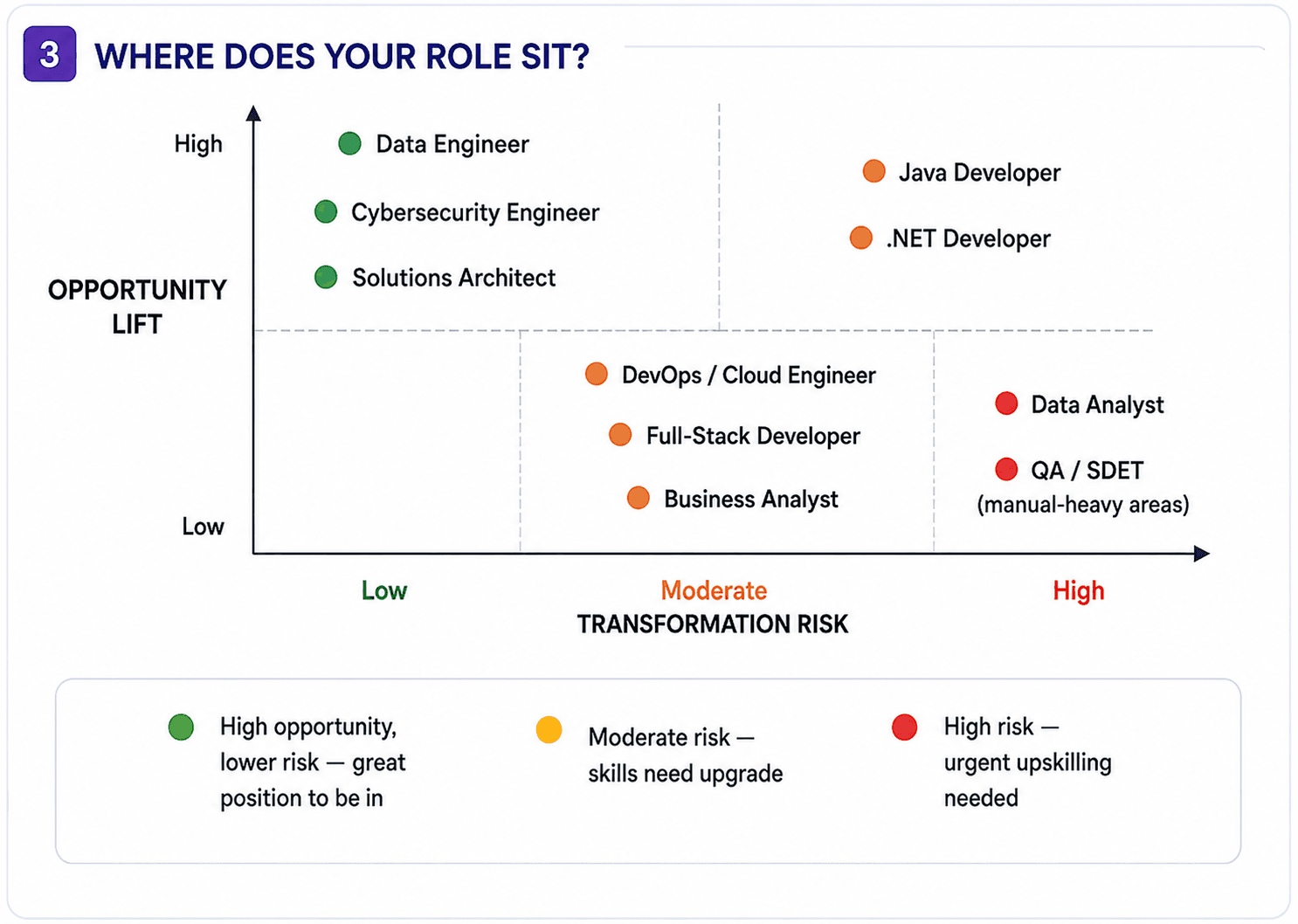
Diagram 5. Transformation risk versus opportunity lift across ten common technology roles.
HotJPT Opportunity Lift is a qualitative indicator (Low/Medium/High/Very High), not a probability of employment. It reflects the direction of posting demand and, where available, sourced occupational growth data. It is not a guarantee of any individual outcome.
Conclusion
Tech isn't simply hiring. Tech isn't simply firing. Tech is changing what it pays people to know.
If your company rewrote your job description tomorrow, how much of your current skill stack would still be on it?
The real question isn't, 'Are companies hiring?' It's: 'What are they hiring for now?'
HotJPT tracks how technology hiring is changing across roles, skills, and employers. Follow HotJPT Pulse for the signals that matter before they become obvious.
Shareable Lines
The job market may not be deleting technology jobs as fast as it's deleting old definitions of technology jobs.
The danger isn't being a Java developer. The danger is being a Java developer whose stack stopped evolving.
Ask not whether your job will disappear; ask which skills are entering it, and get there first.
Frequently Asked Questions
Is the tech job market bad in 2026?
It's mixed. Tech layoffs are up 67% year-over-year through July 2026, but tech also leads every industry in announced hiring plans. Software postings remain about a quarter below pre-pandemic levels while recovering from a 2025 low.
Are software developer jobs declining?
Postings remain below pre-pandemic levels, but they've been rising since mid-2025, driven mostly by senior roles and AI-related titles rather than a broad-based recovery.
Is AI replacing software developers?
Evidence points to AI reshaping the role more than eliminating it — automating routine coding tasks while increasing demand for developers who can build with AI tools (RAG, agents, LLM integration).
What AI skills should Java developers learn?
RAG, vector databases, Spring AI or LangChain4j, LLM API integration, tool-calling/agent patterns, and AI application security are the most directly relevant additions to a Java stack right now.
Which technology jobs are growing fastest?
Data roles and cybersecurity roles show the strongest sourced growth signals among tracked tech occupations.
Will software engineering become obsolete because of AI?
Nothing in current labor data supports a full-obsolescence timeline. What the data supports is competitive pressure on the traditional version of the role over the next 3–5 years, concentrated in the most repetitive parts of the job.
The HotJPT editorial team covers AI, US immigration, IT job market trends, and staffing intelligence for recruiters, bench sales marketers, and IT consultants.